
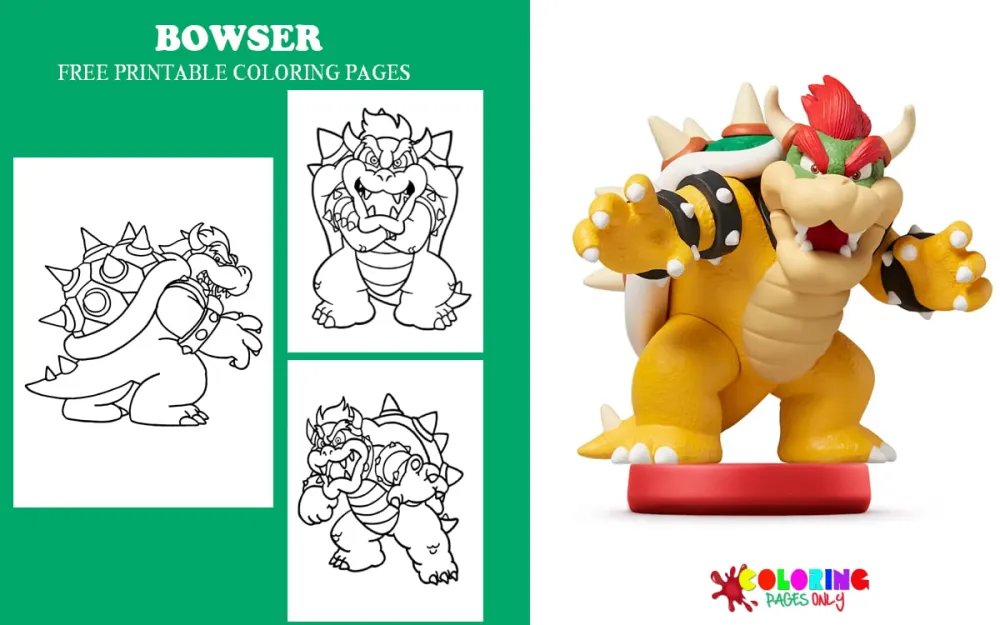
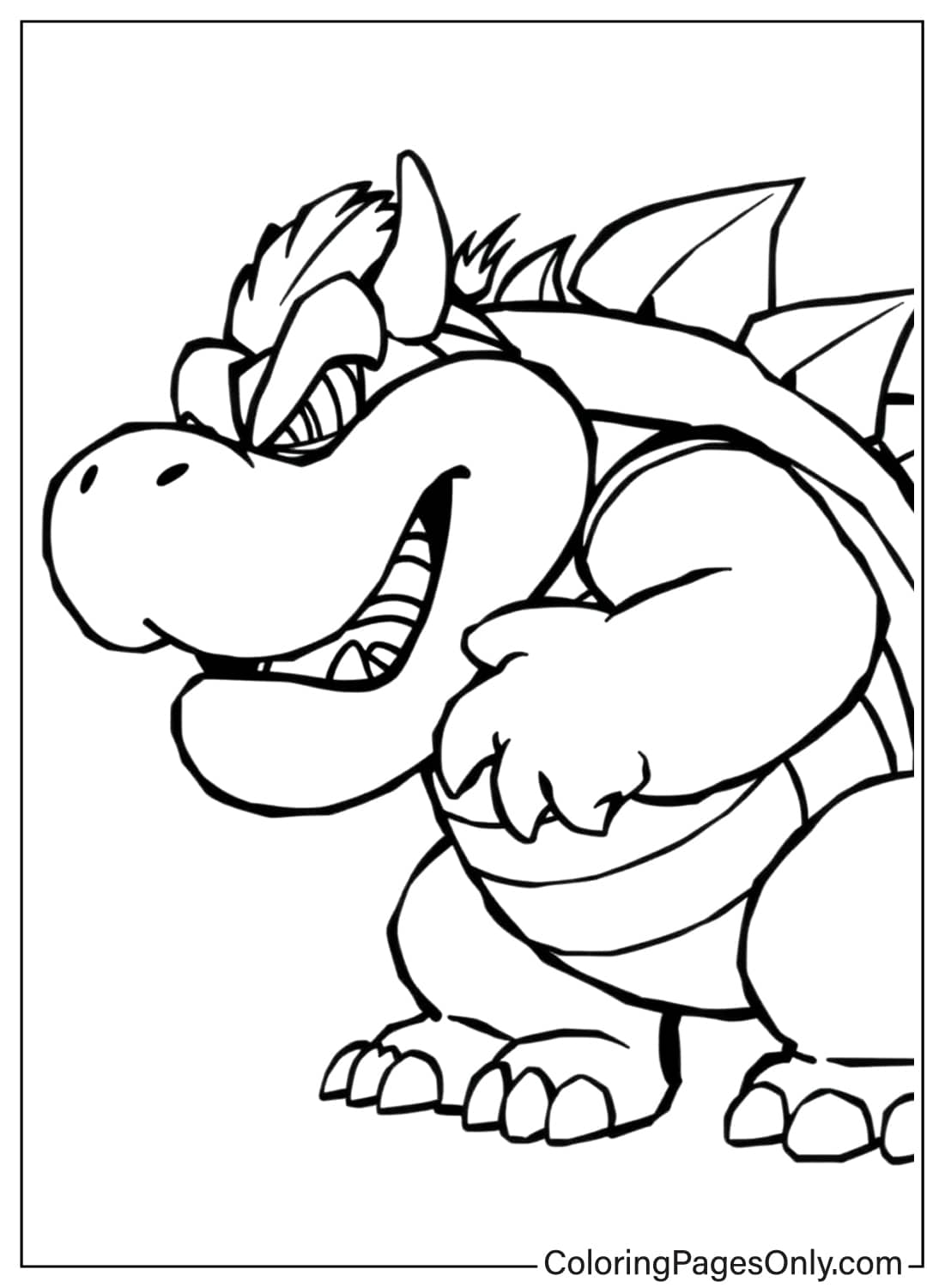
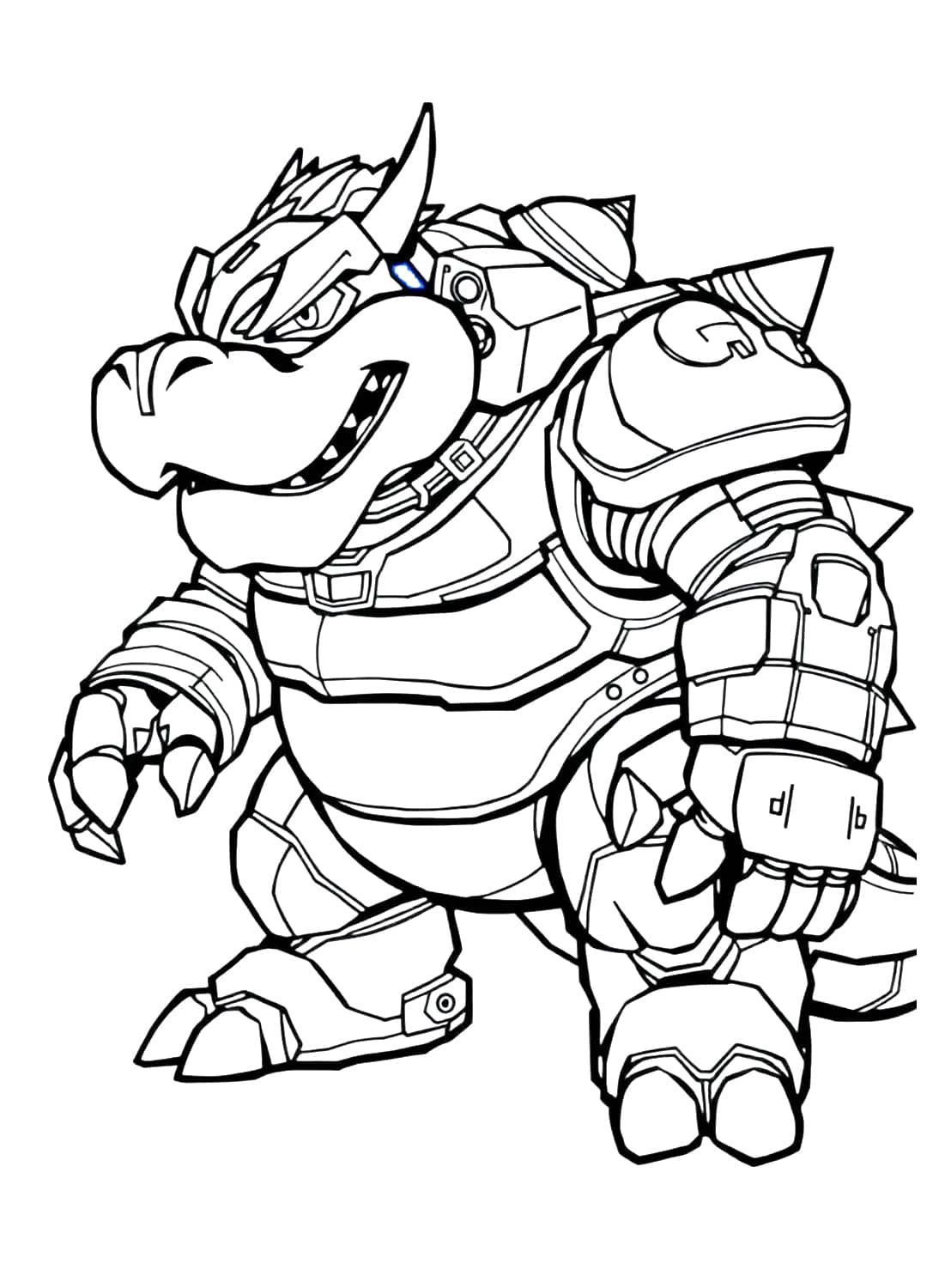
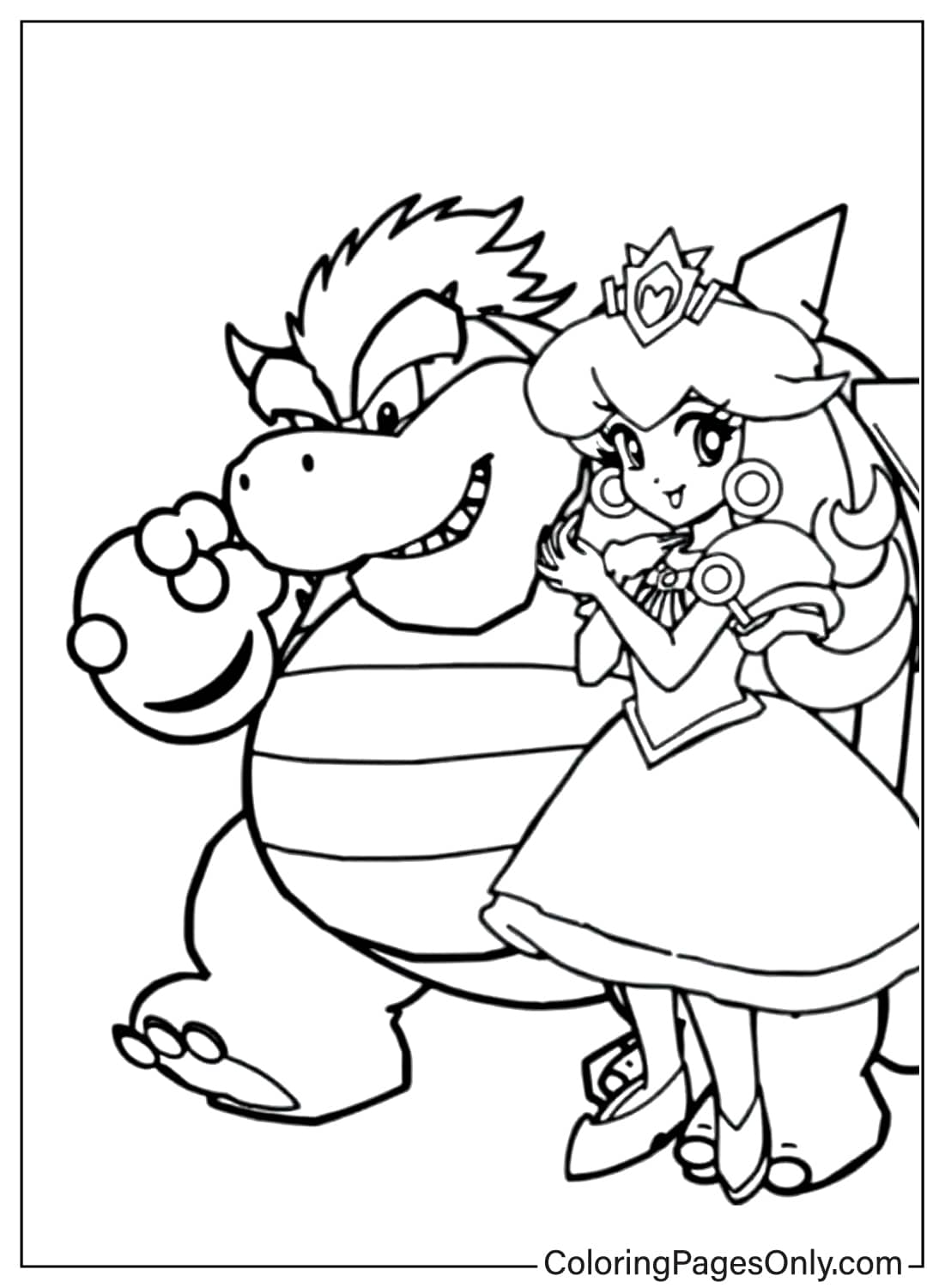
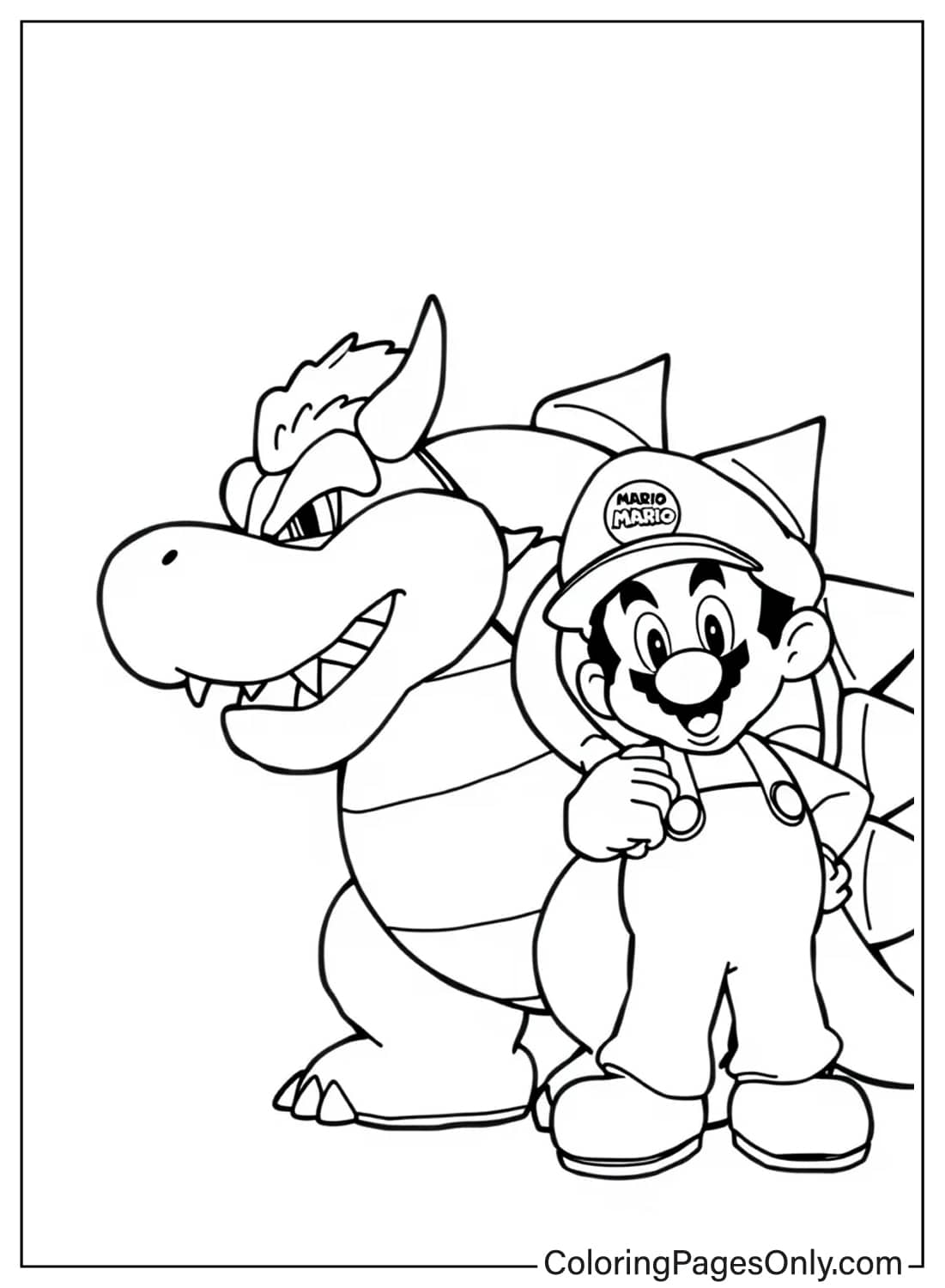
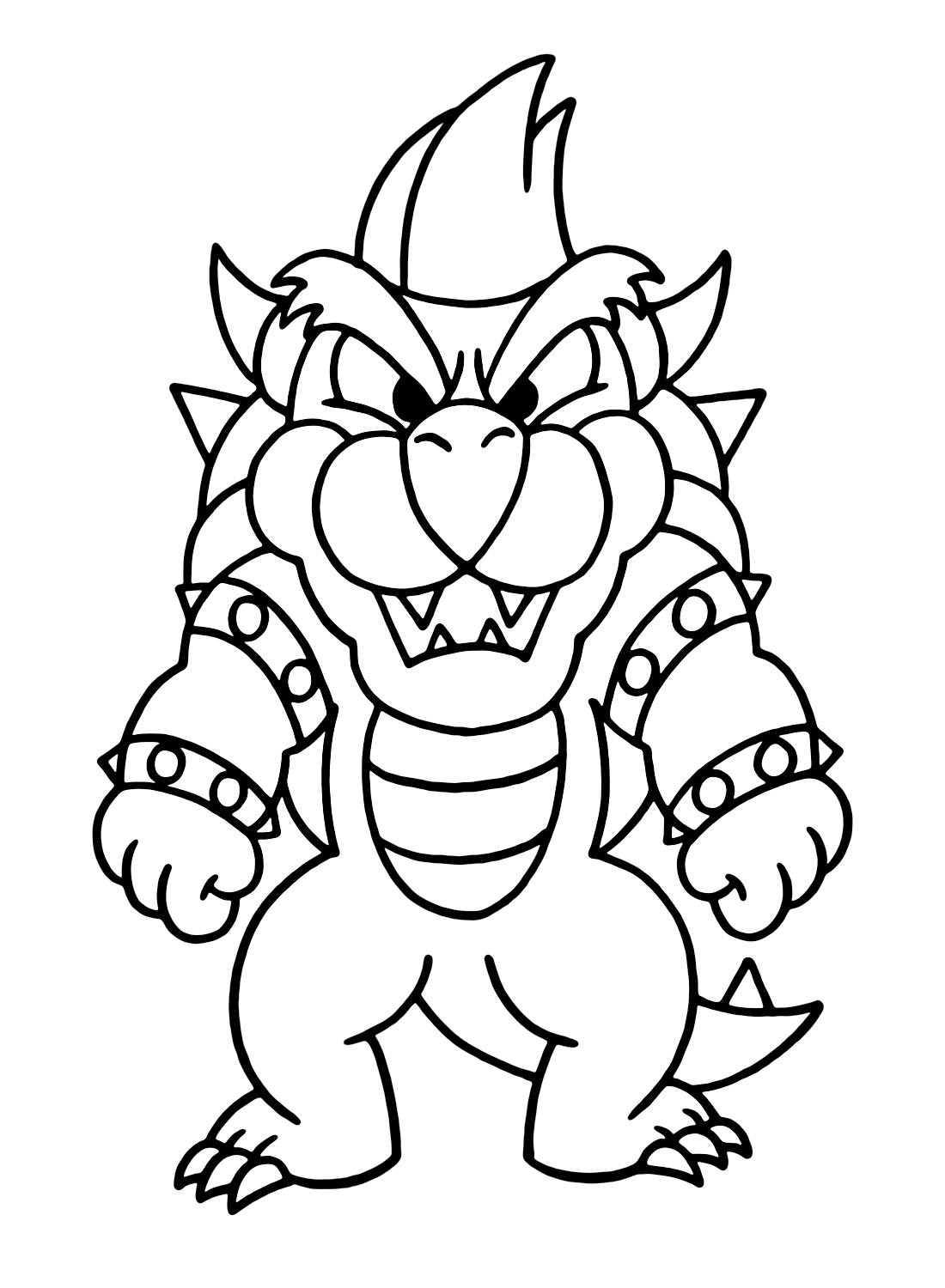
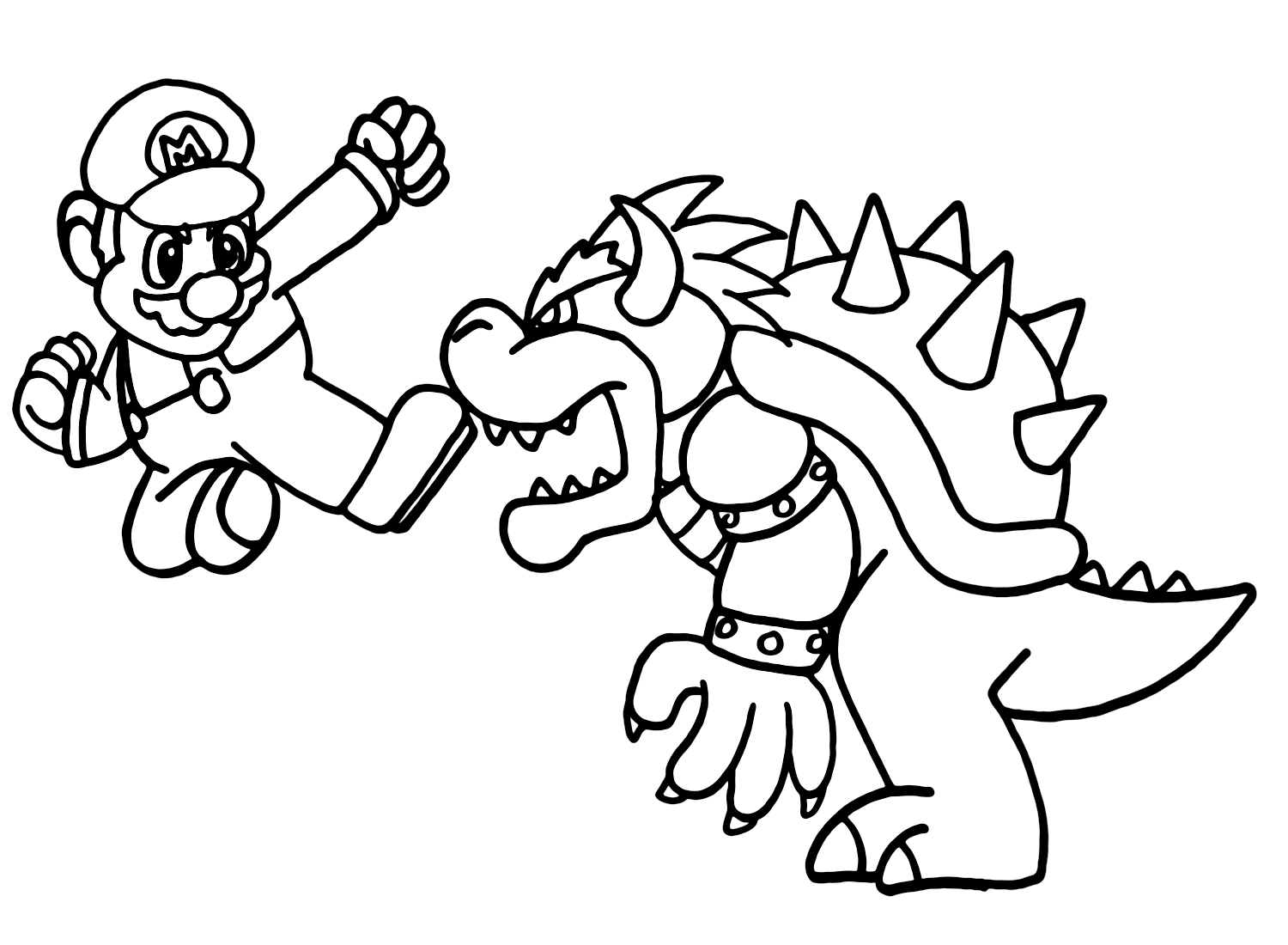
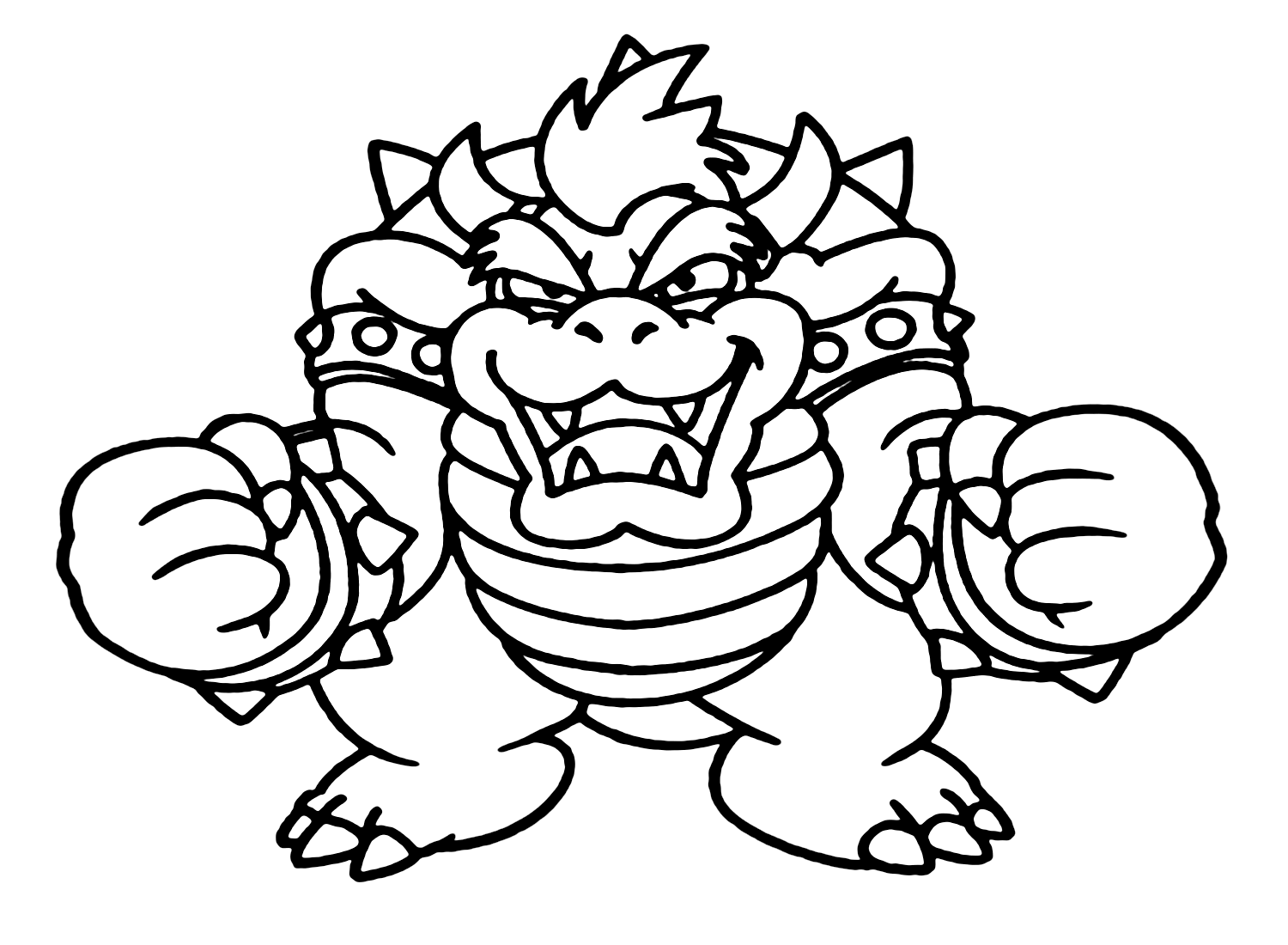
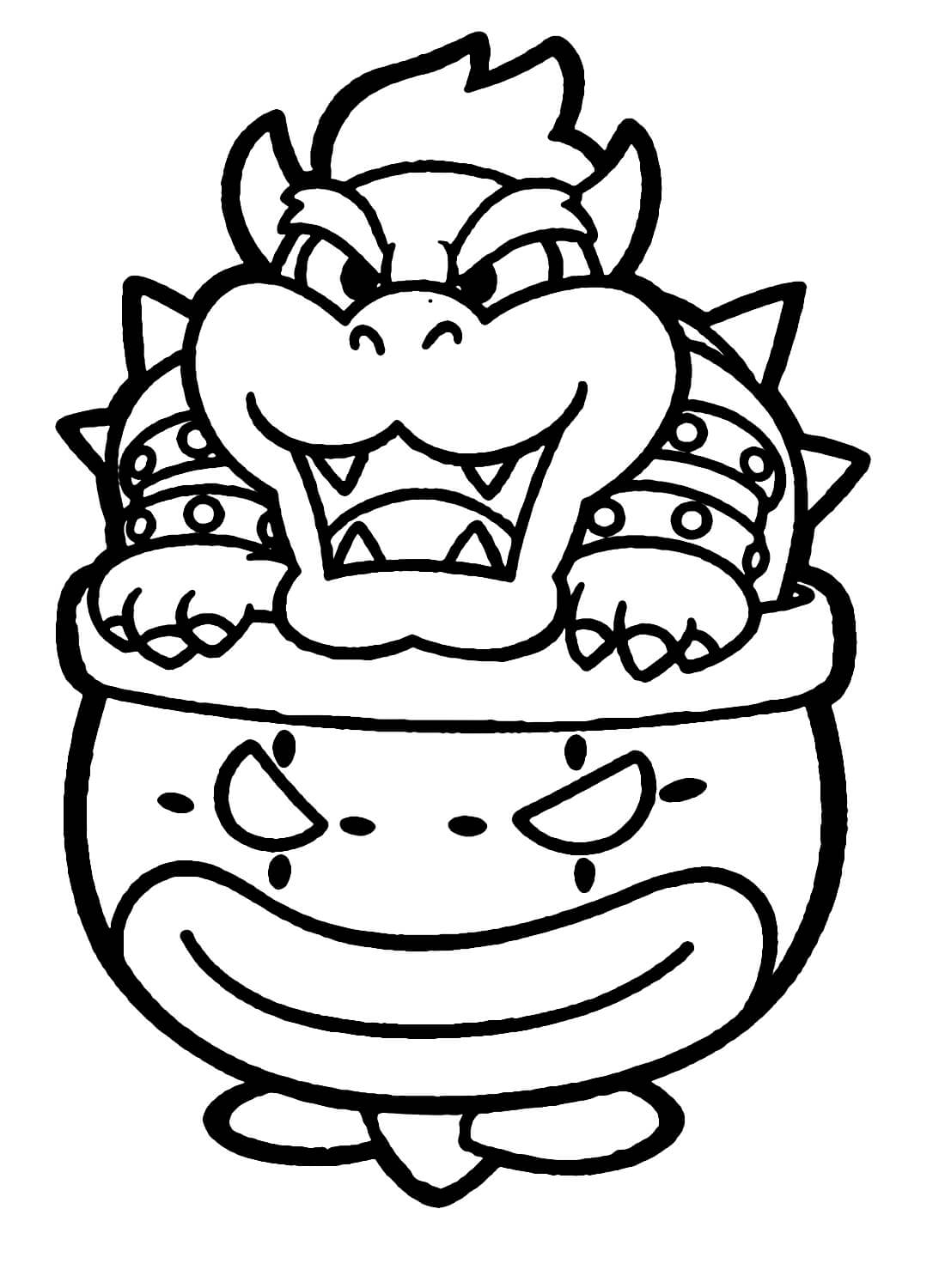
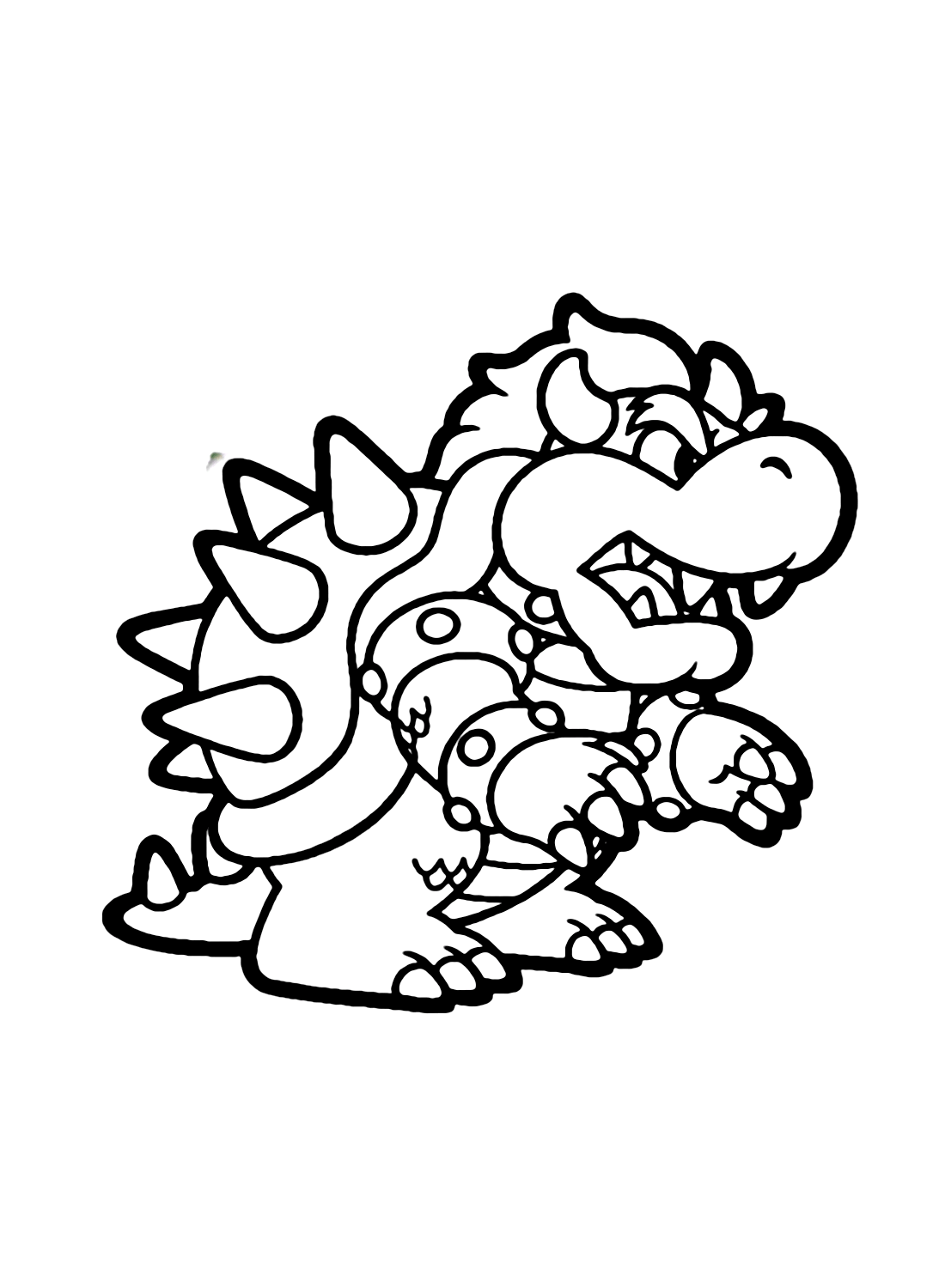
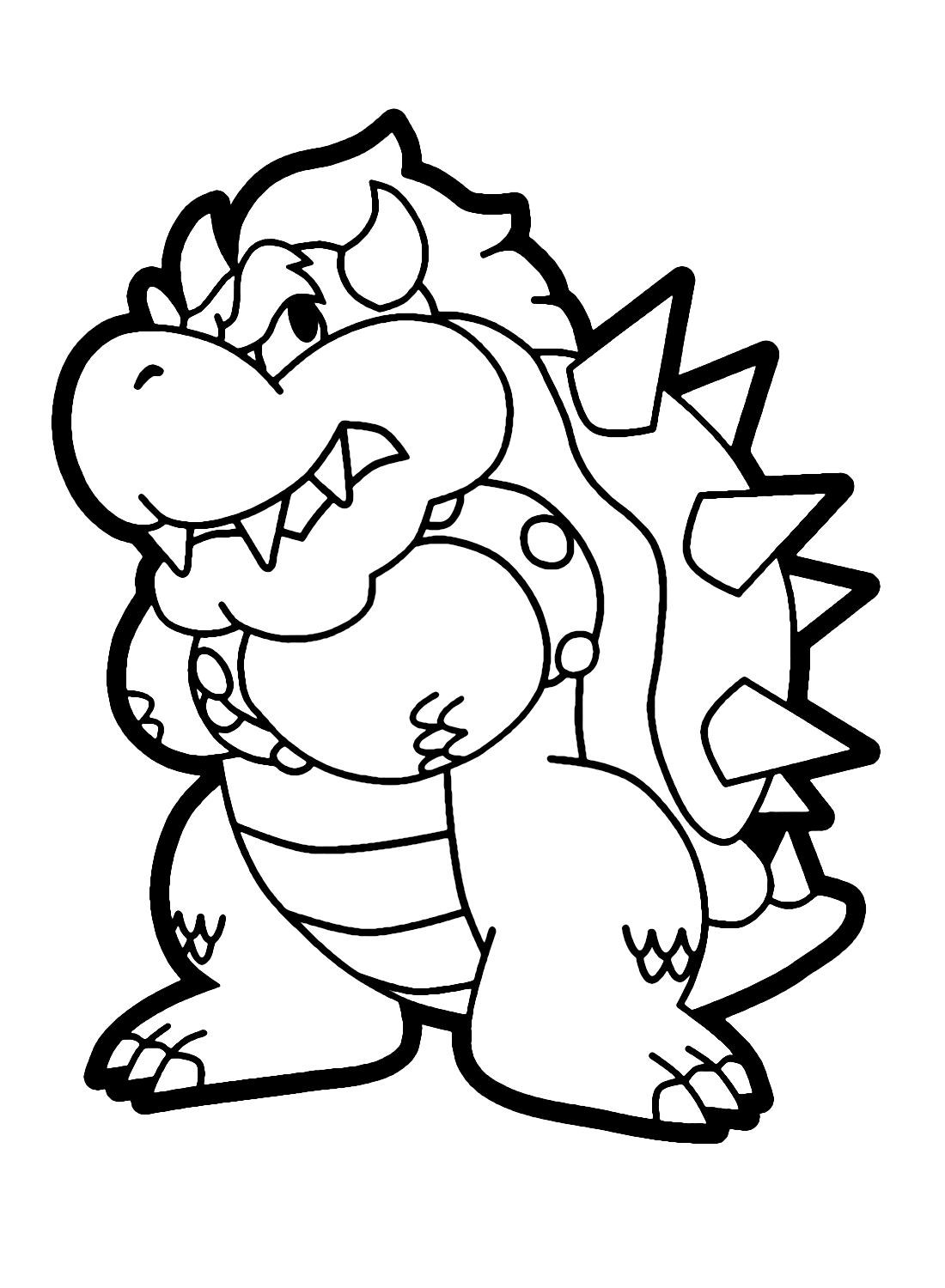
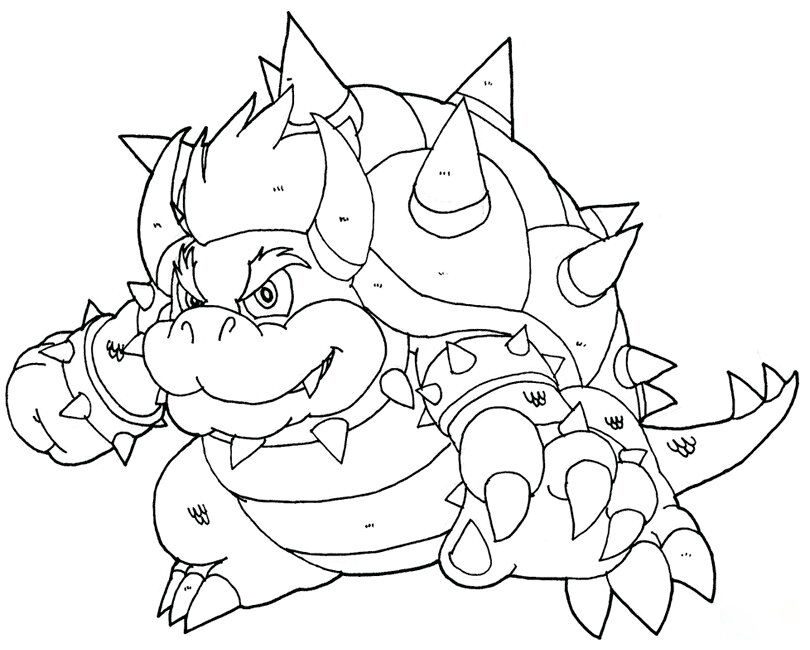
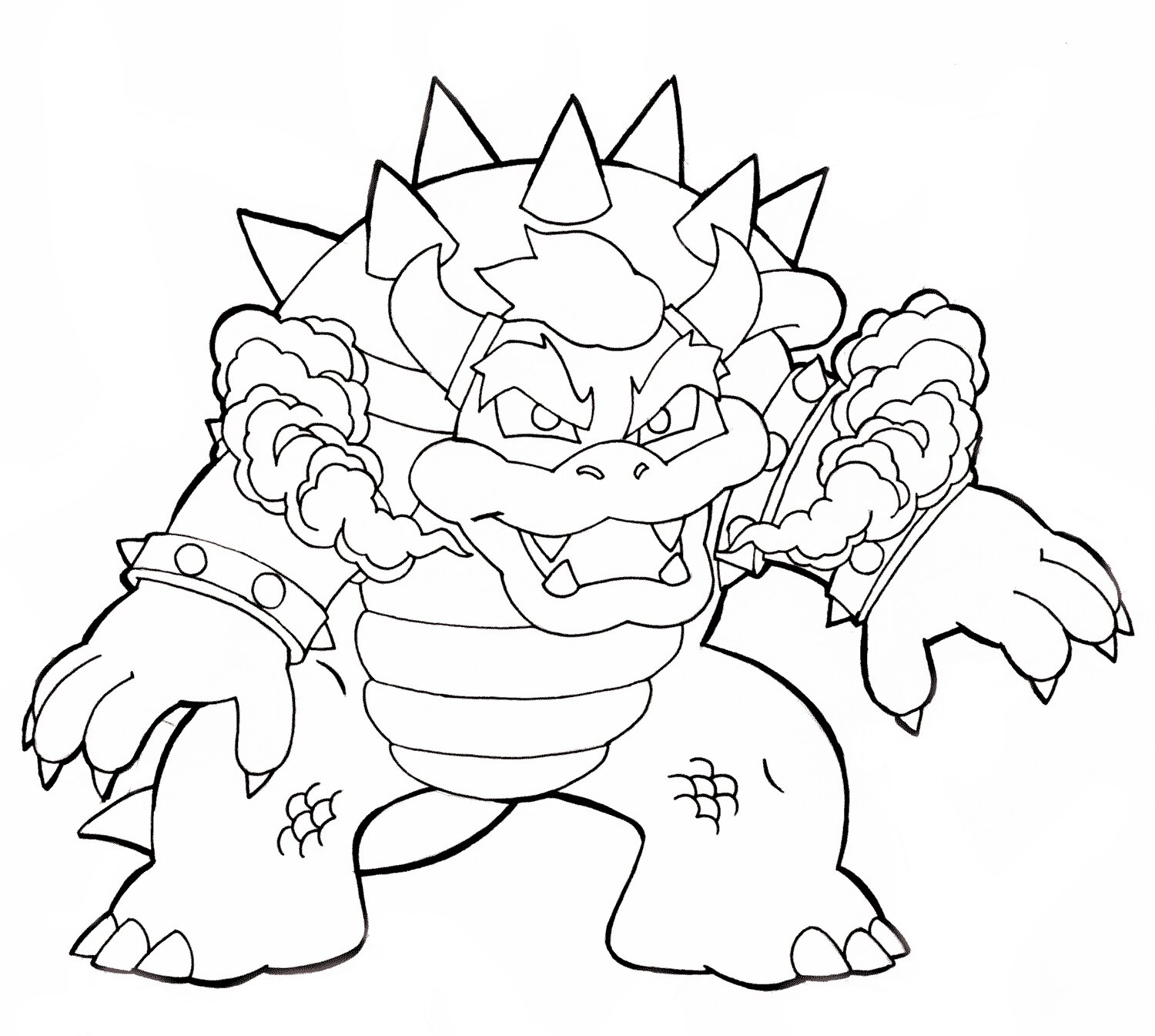
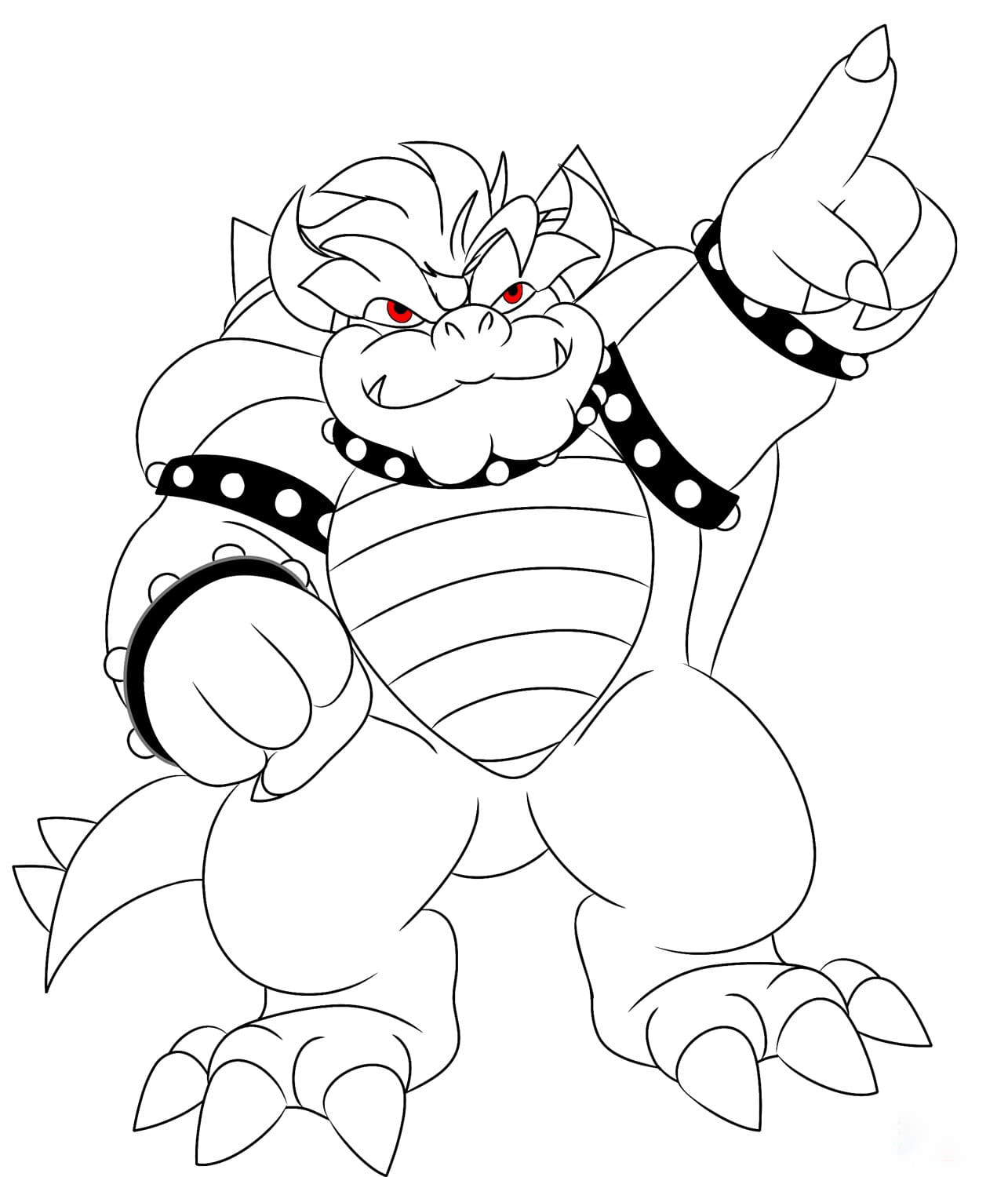
Free Bowser coloring pages: 30+ pages featuring the King of the Koopas in roaring combat stances with spiked shell and crown, fire-breathing action scenes with vivid flame effects, close-up portrait studies of his horned and tusked face, Dry Bowser in skeletal form, Fury Bowser in the dark ink-covered giant form from Bowser’s Fury, Bowser Jr. alongside his father, Mario Kart racing poses, Bowser’s castle environment scenes, and the full visual vocabulary of gaming’s most recognizable antagonist across forty years of the Super Mario franchise. All free, printable PDF and online coloring for Mario fans of all generations.
Bowser first appeared in Super Mario Bros., released in Japan on September 13, 1985, for the Nintendo Famicom and in North America on October 18, 19,85 for the Nintendo Entertainment System. The game was created by Shigeru Miyamoto and Takashi Tezuka. Bowser’s visual design was developed by character designer Yoichi Kotabe in collaboration with Miyamoto: a large, bipedal turtle-dragon hybrid combining the shell and general form of a turtle with the horns, fangs, and fire-breathing capability of a dragon, wearing a spiked collar and wristbands that suggest military command. His Japanese name, Koopa (クッパ, Kuppa), derives from the Korean rice dish gukbap (국밥), a choice that reflected the era’s tendency to name Koopa enemies after foods.
He has appeared in every major Super Mario game since 1985 and has been established across forty years as the primary recurring antagonist of one of the world’s most commercially successful video game franchises. The Super Mario franchise has sold over 900 million games worldwide as of 2024. The 2023 Illumination animated film The Super Mario Bros. Movie, in which Jack Black voiced Bowser, earned $1.362 billion worldwide and included a Bowser original song, “Peaches,” that received a nomination for the Academy Award for Best Original Song at the 96th Academy Awards in 2024.
These 30+ free pages at ColoringPagesOnly.com cover Bowser across his full visual history. All free, PDF or PNG, print or color online.
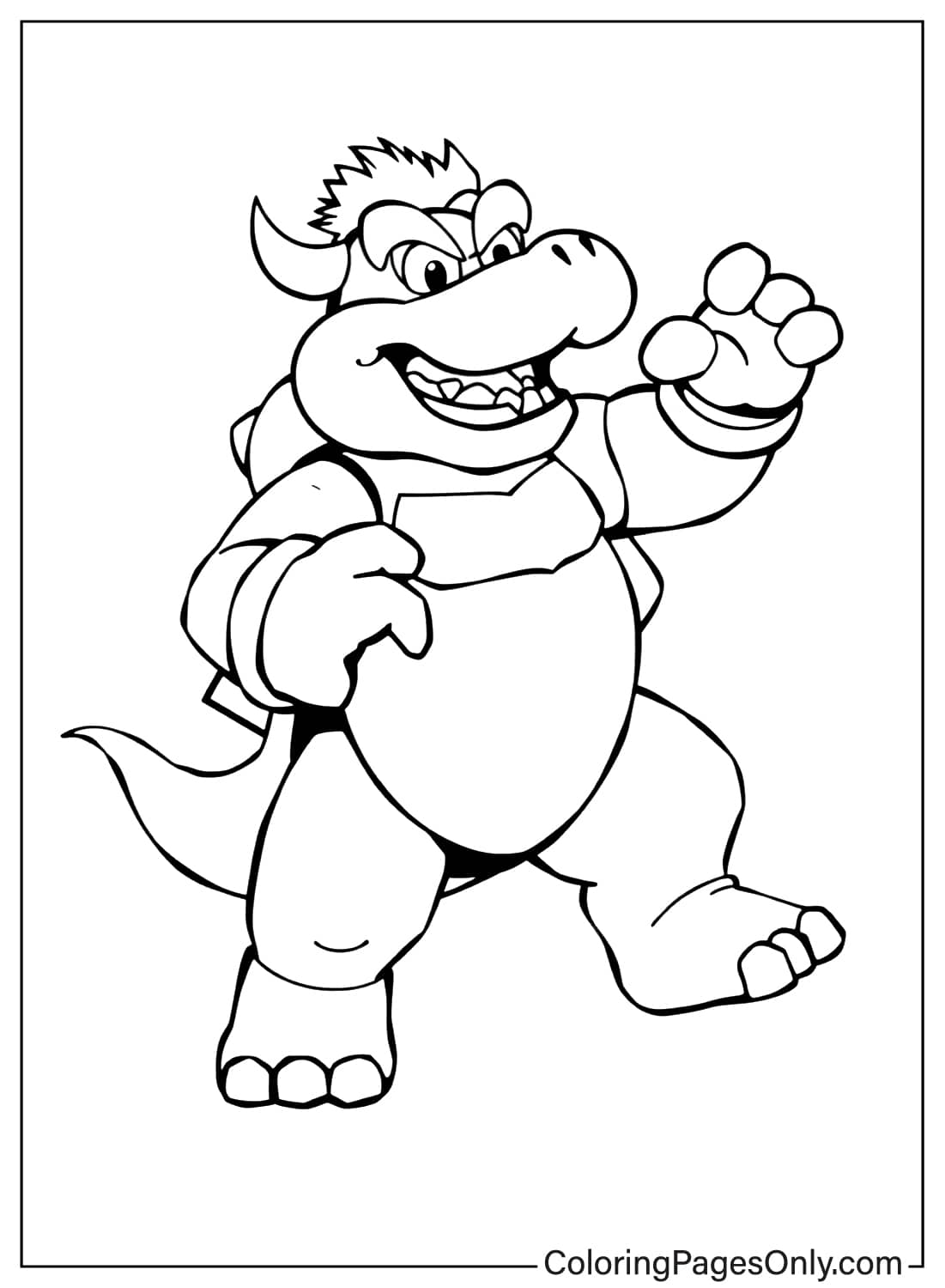
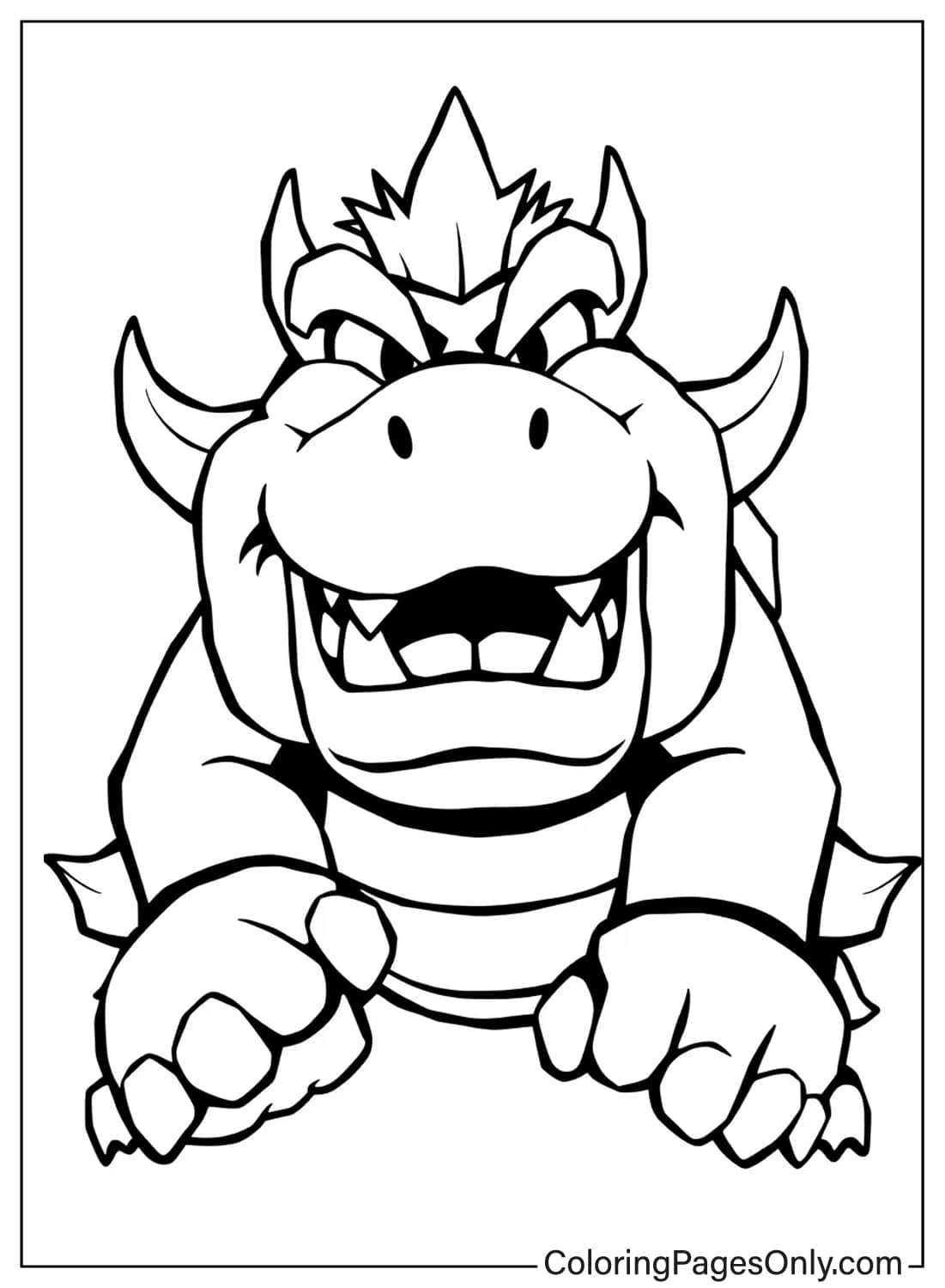
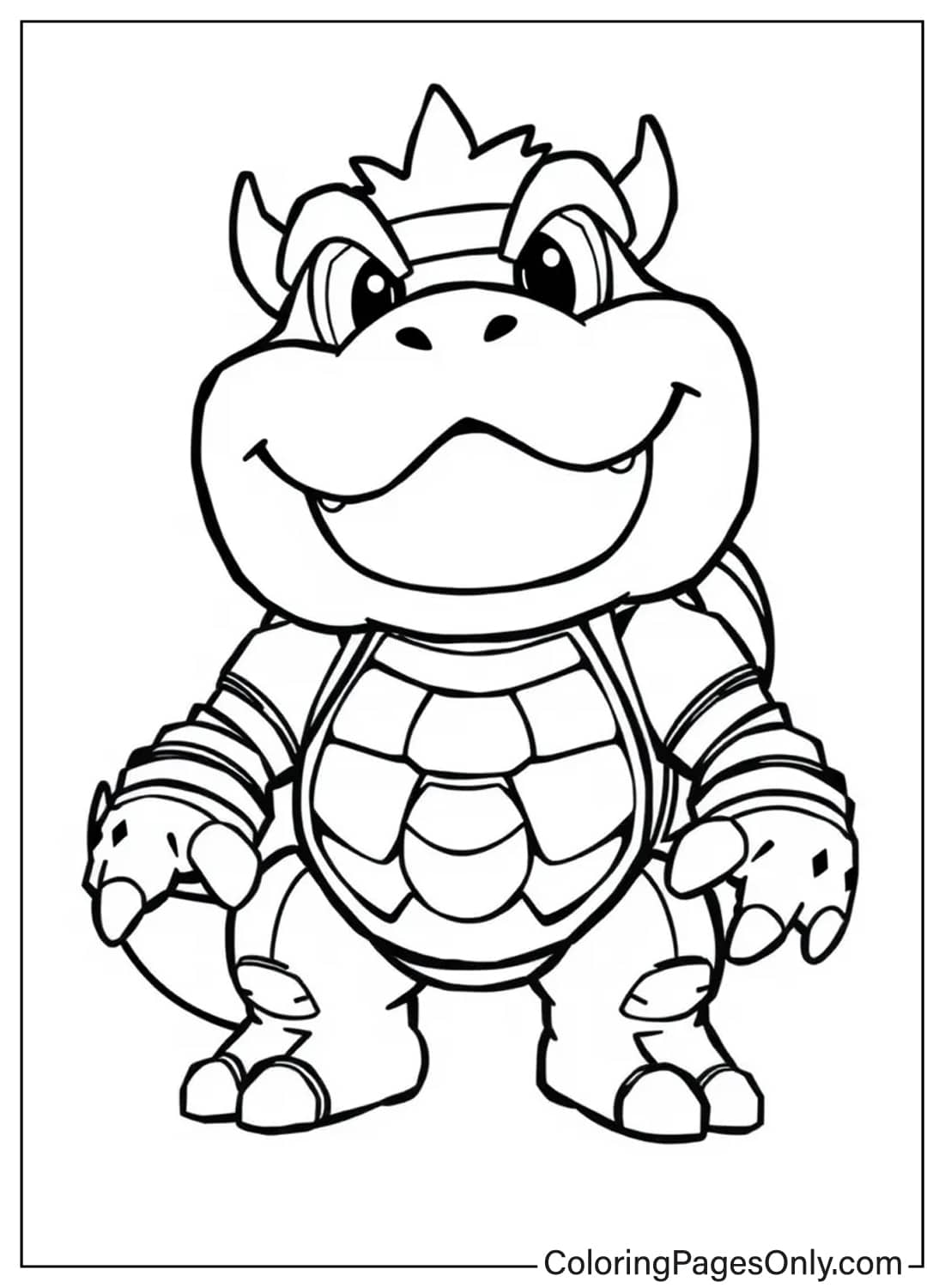
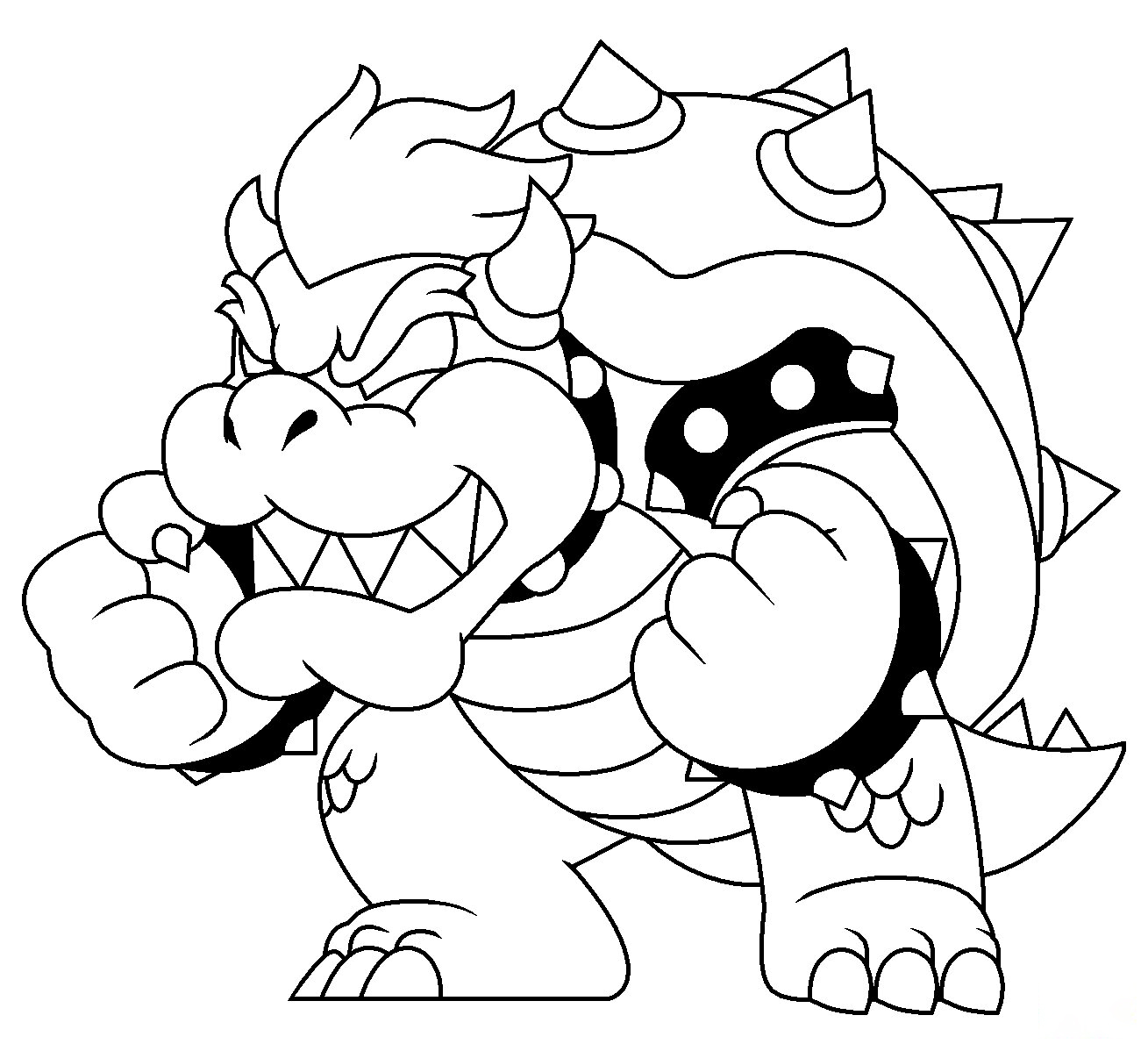
What’s Inside
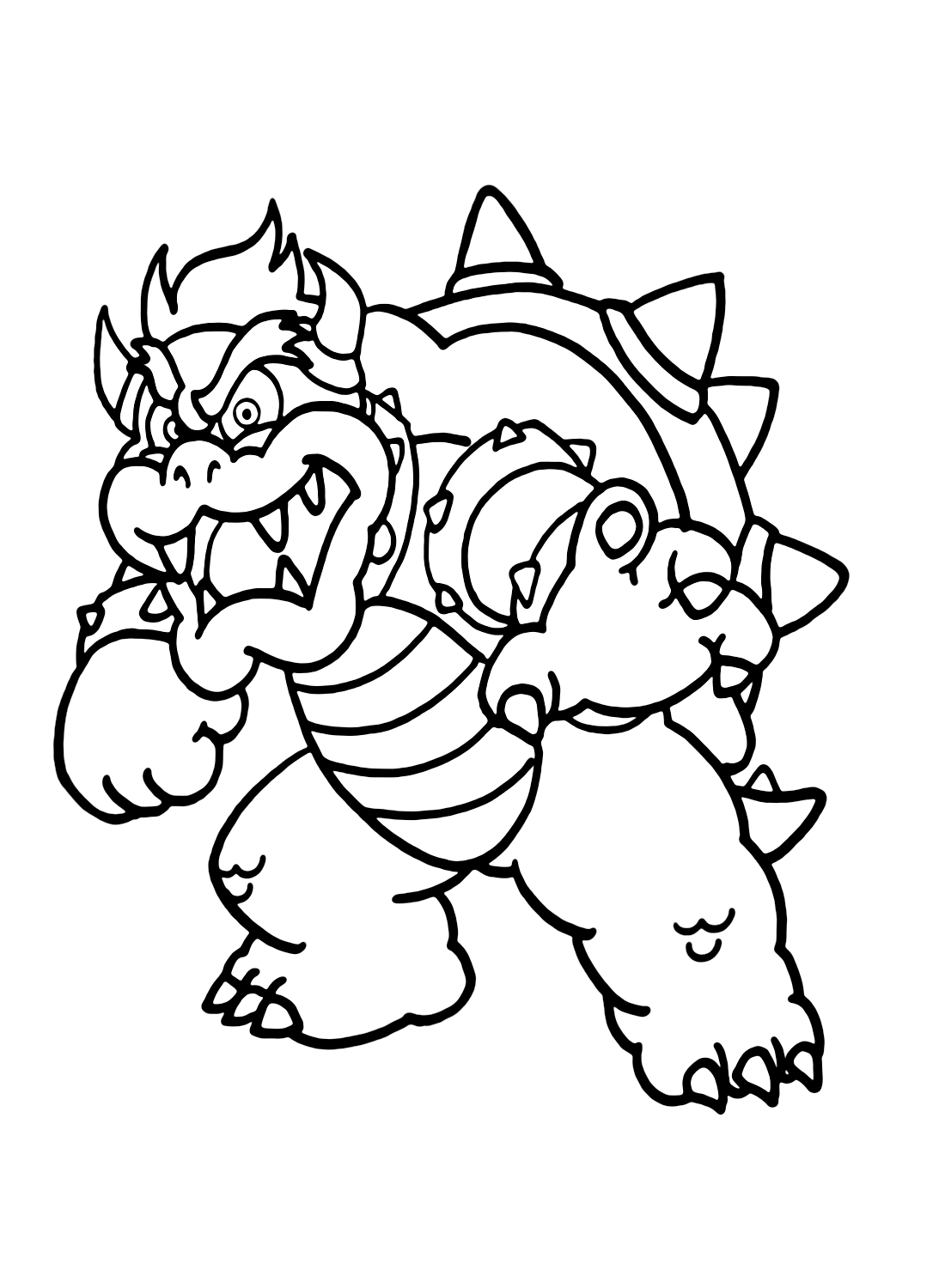
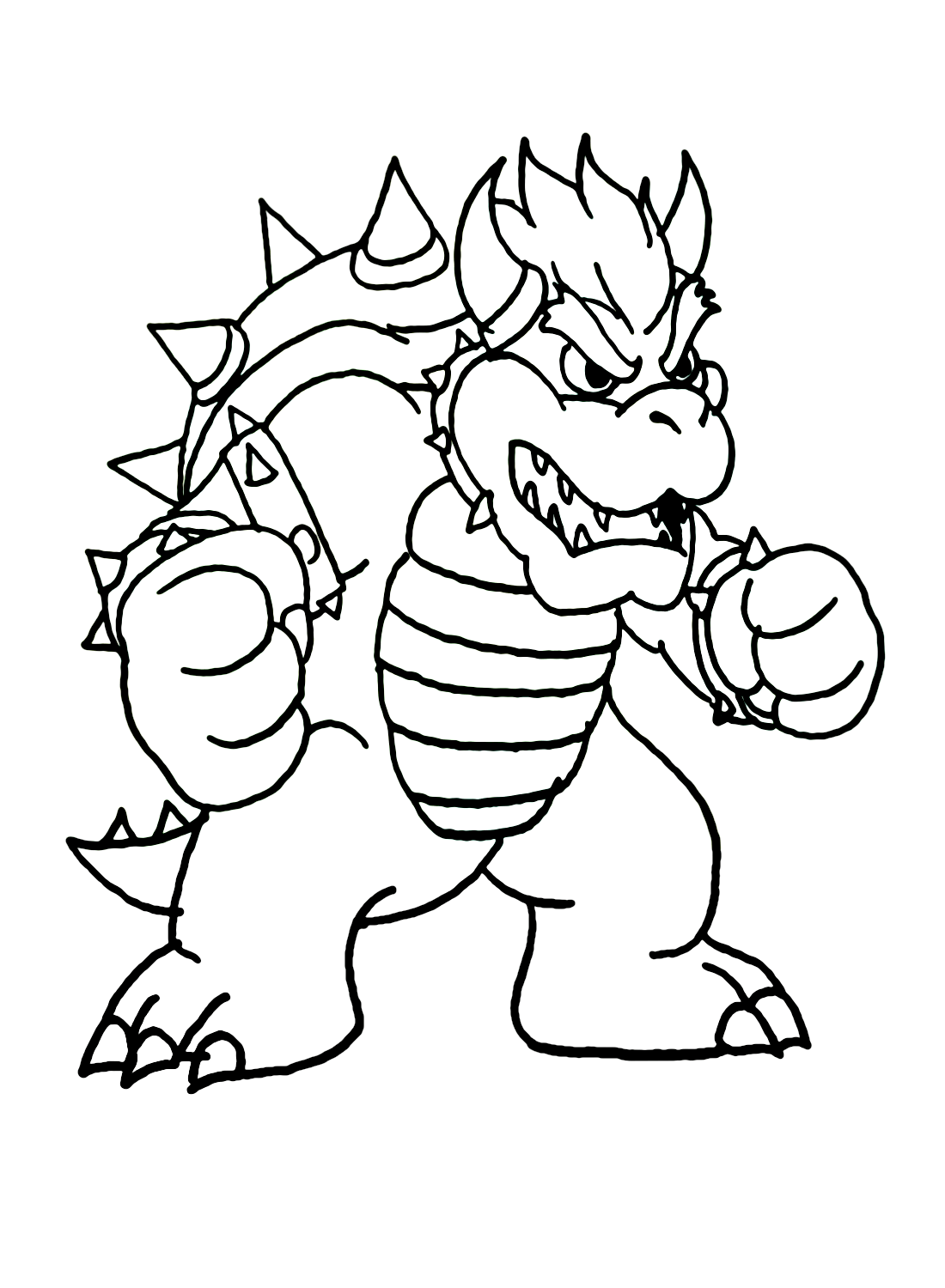
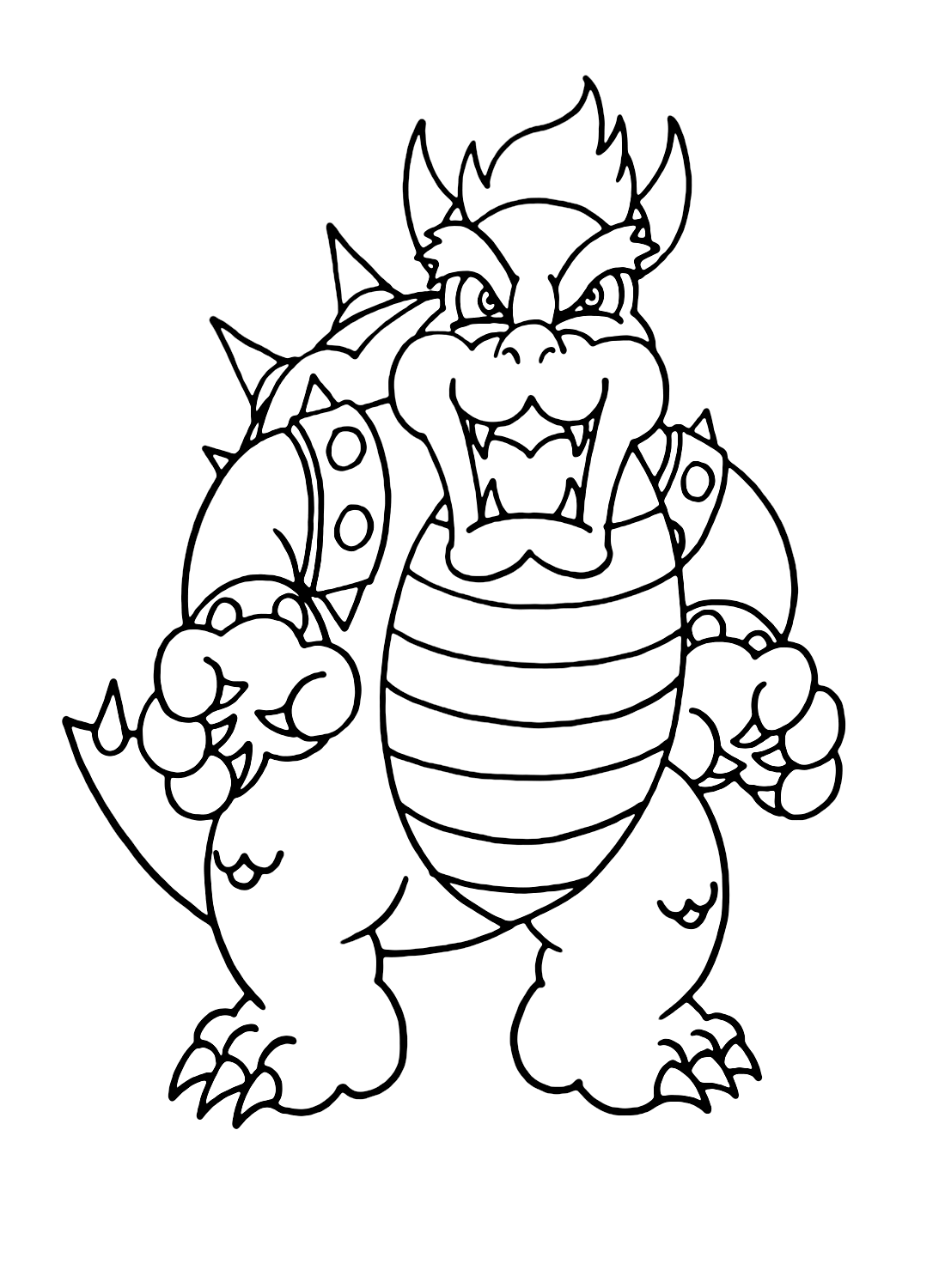
Bowser’s Classic Design: Portrait and Standing Pages
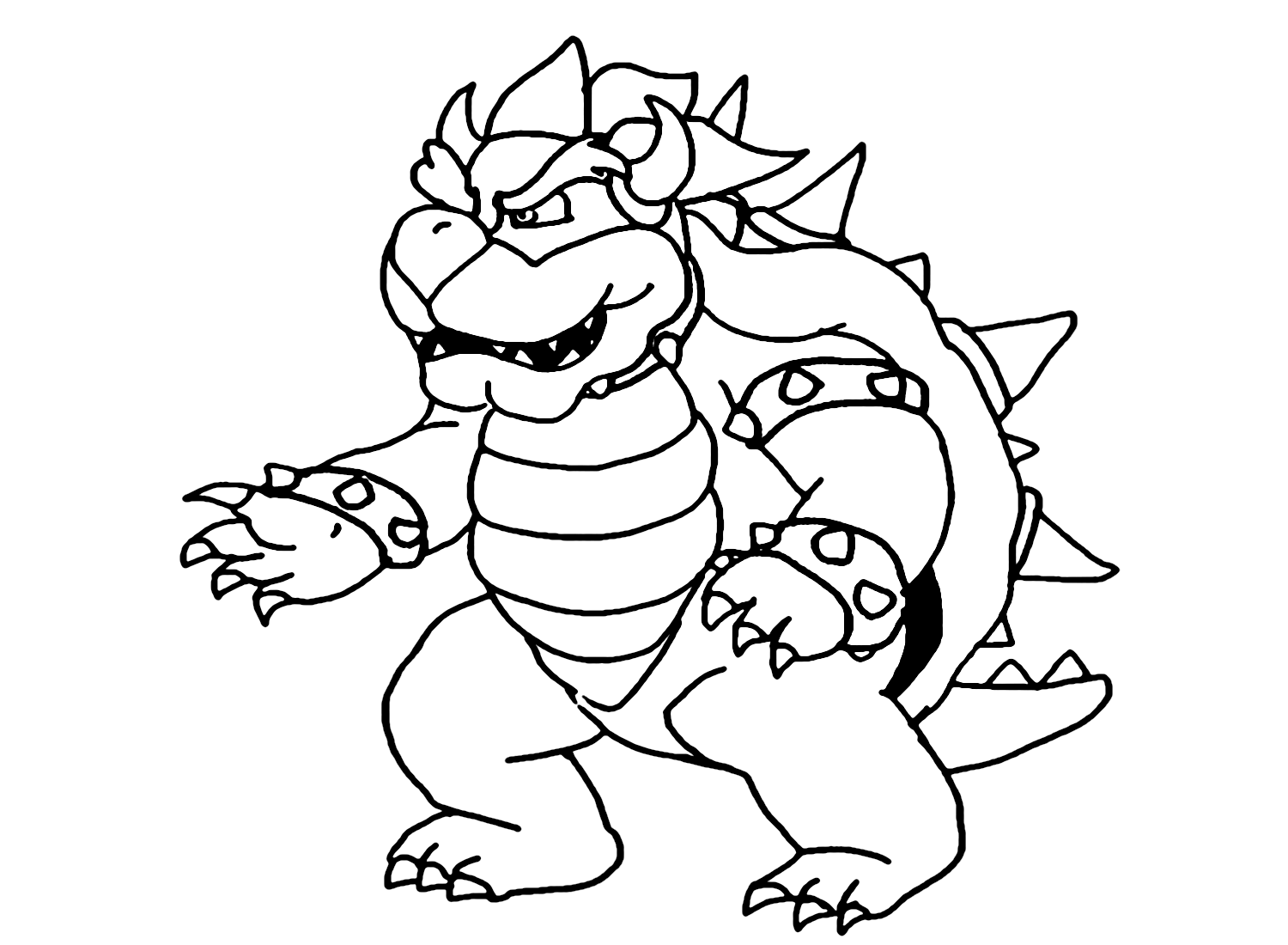
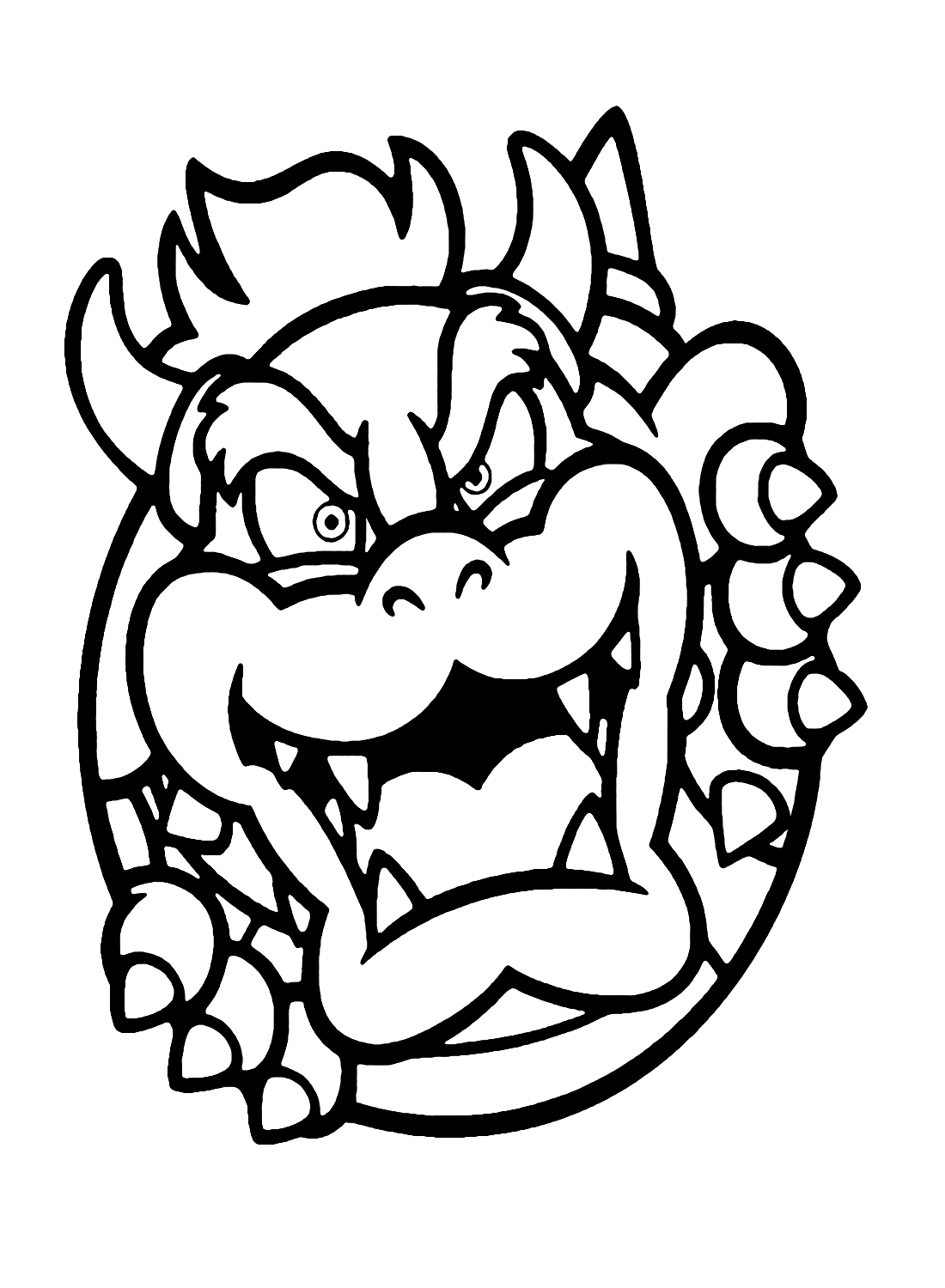
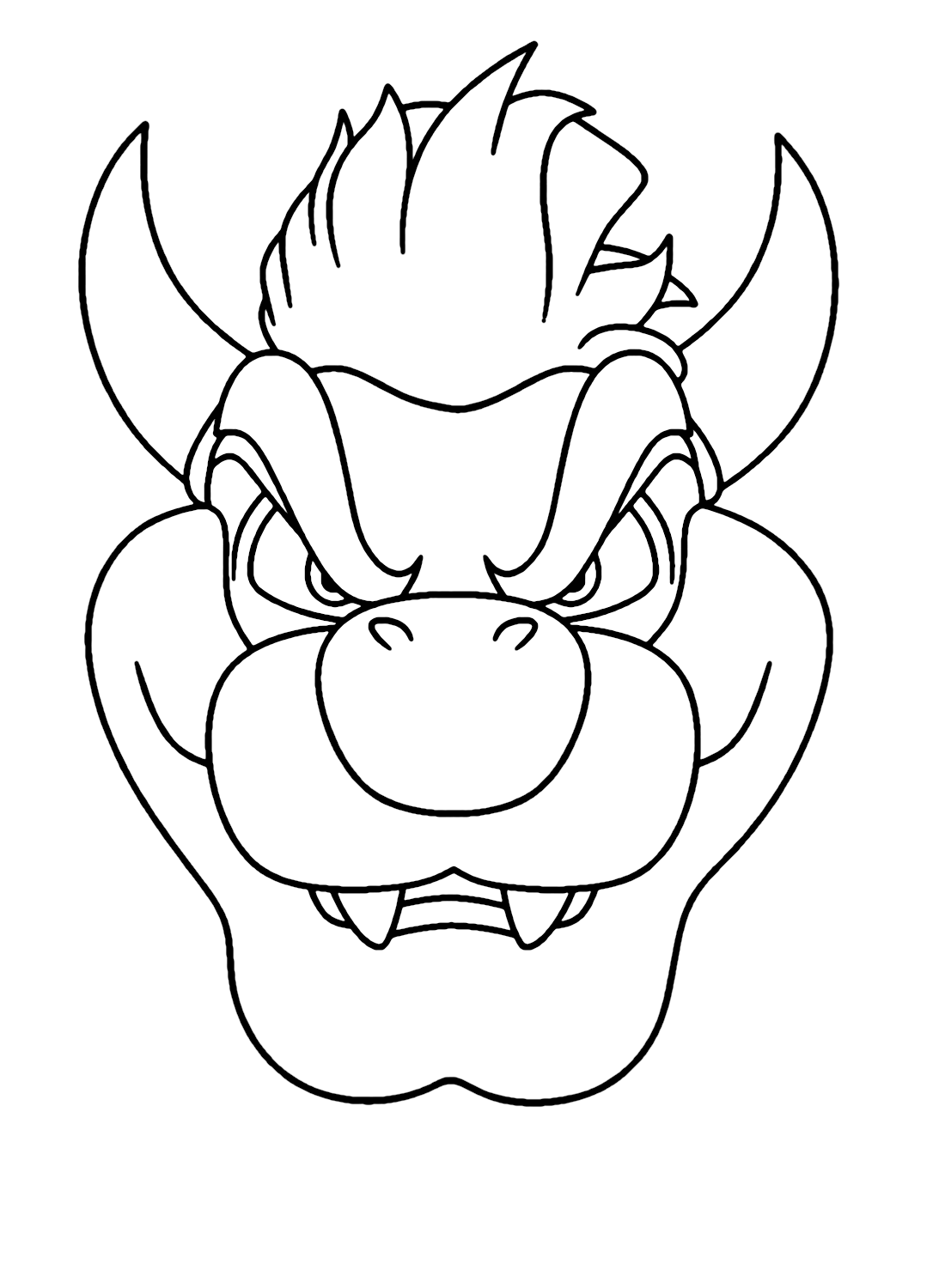
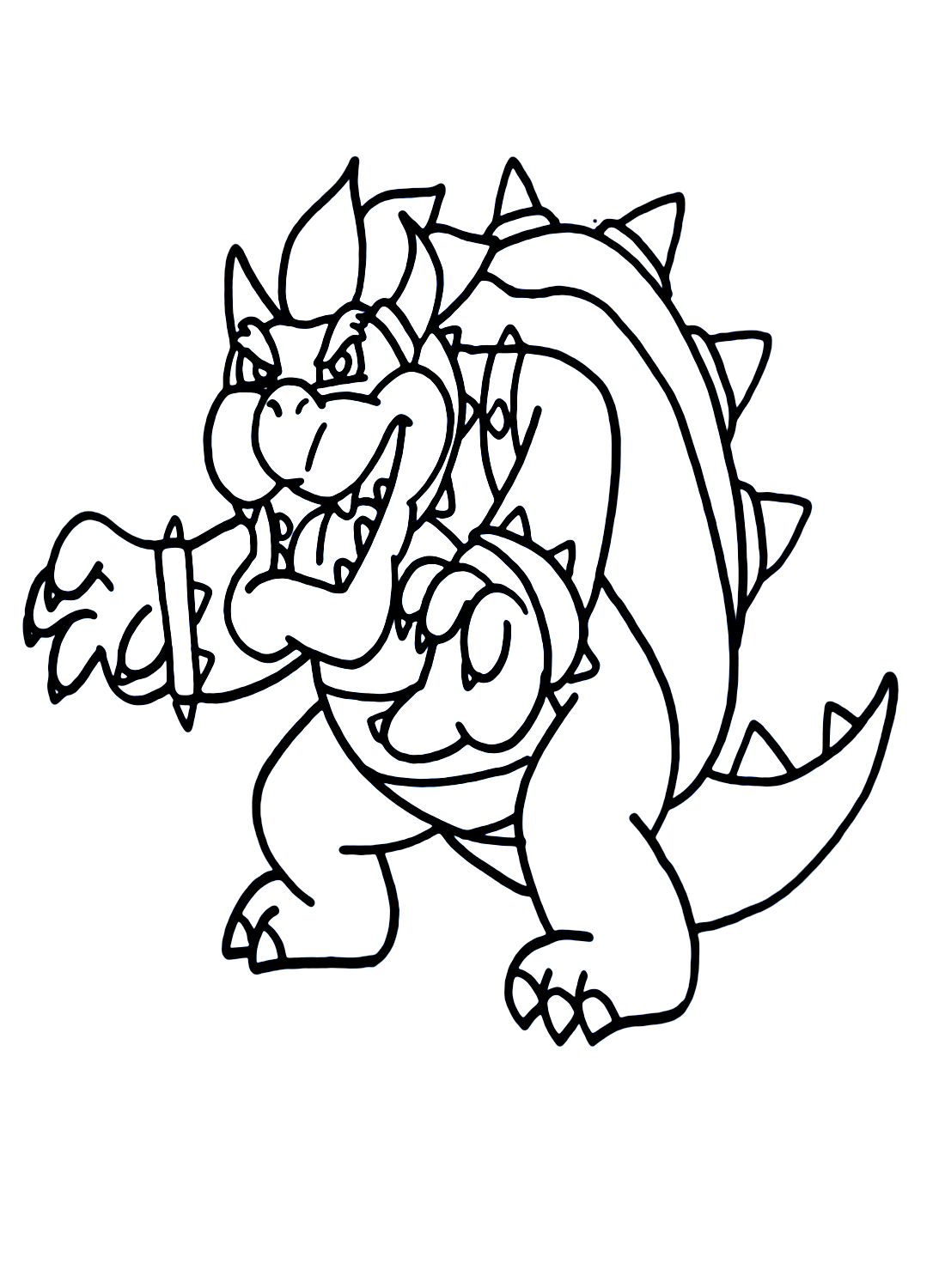
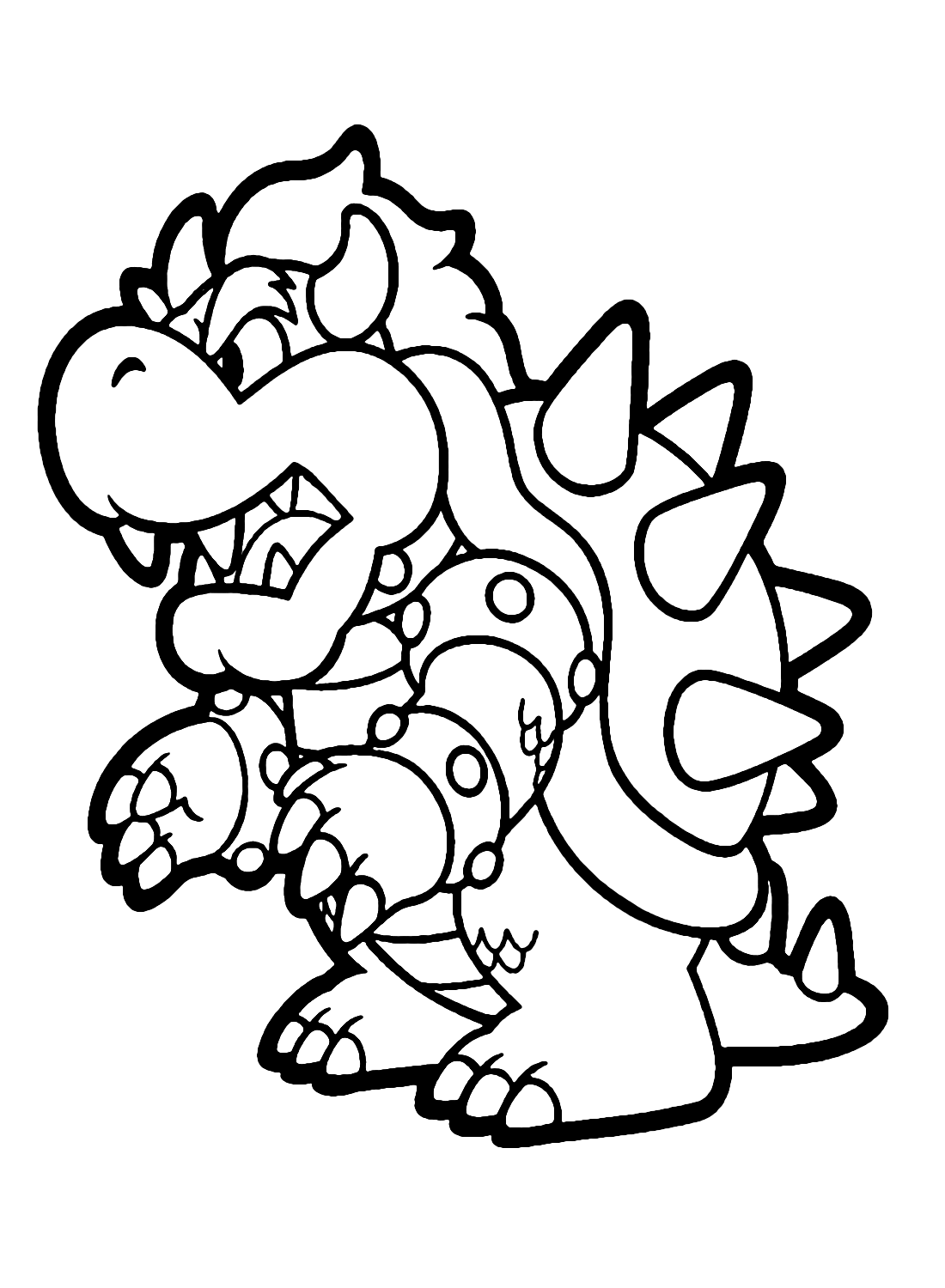
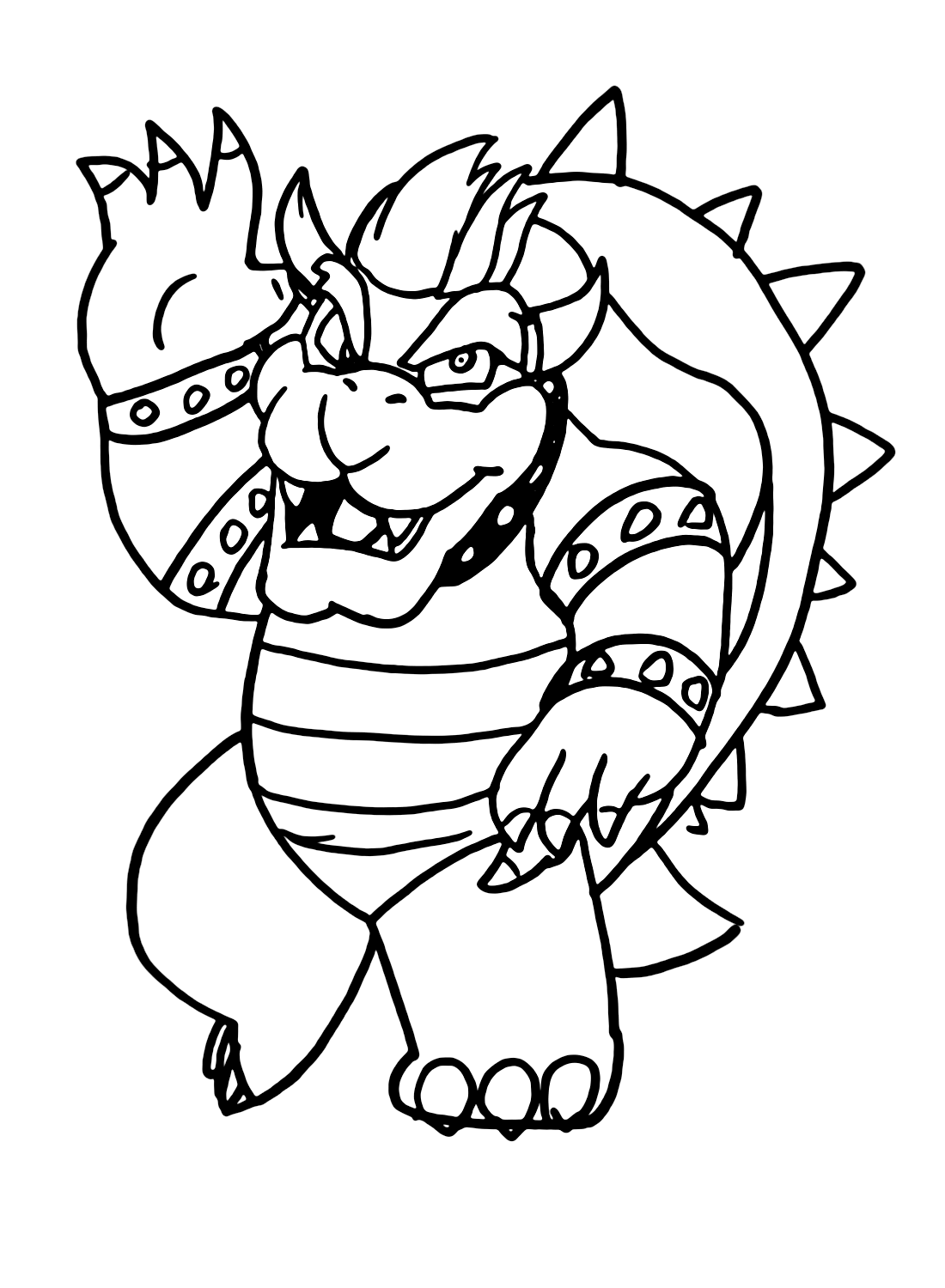
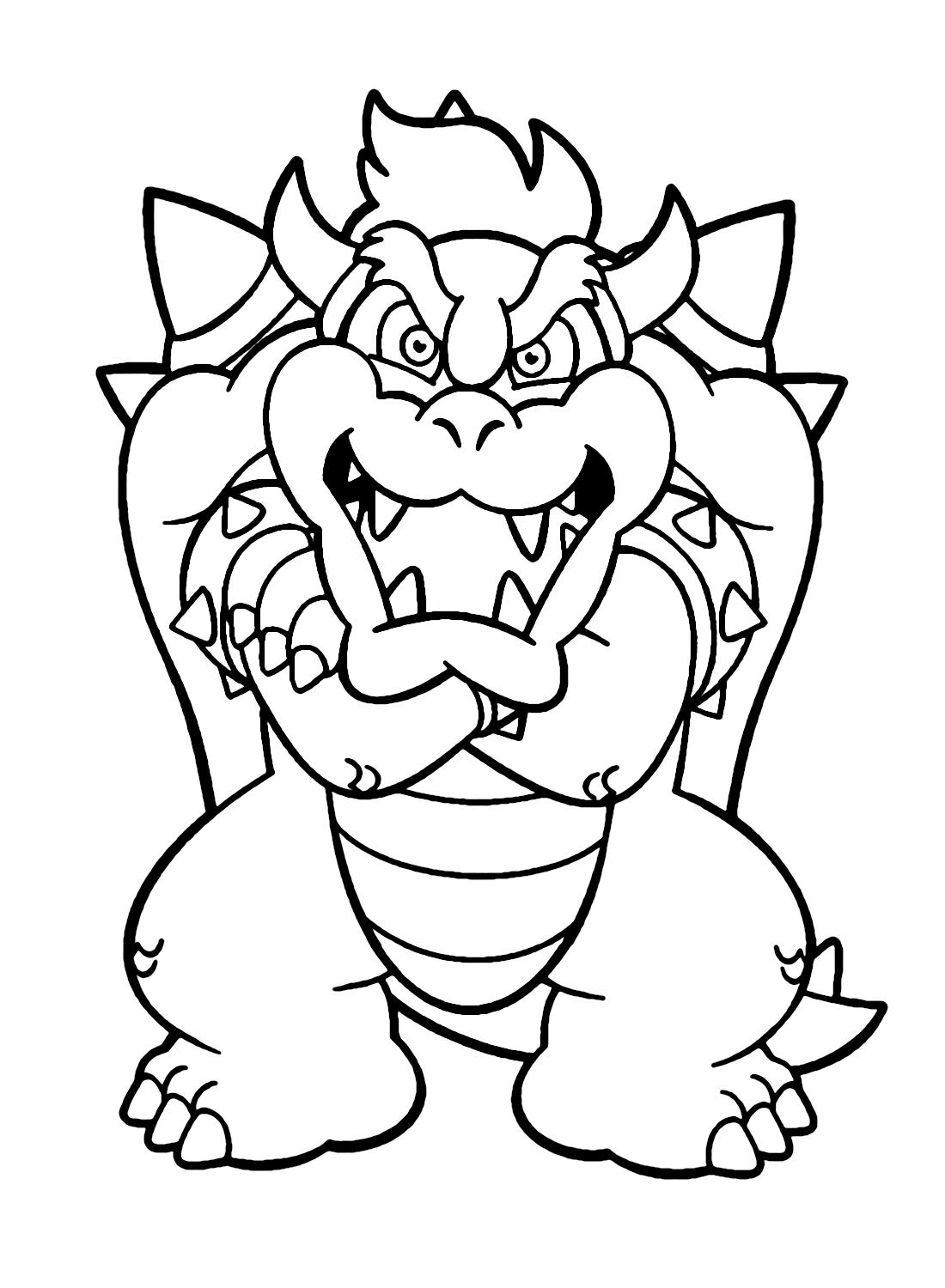
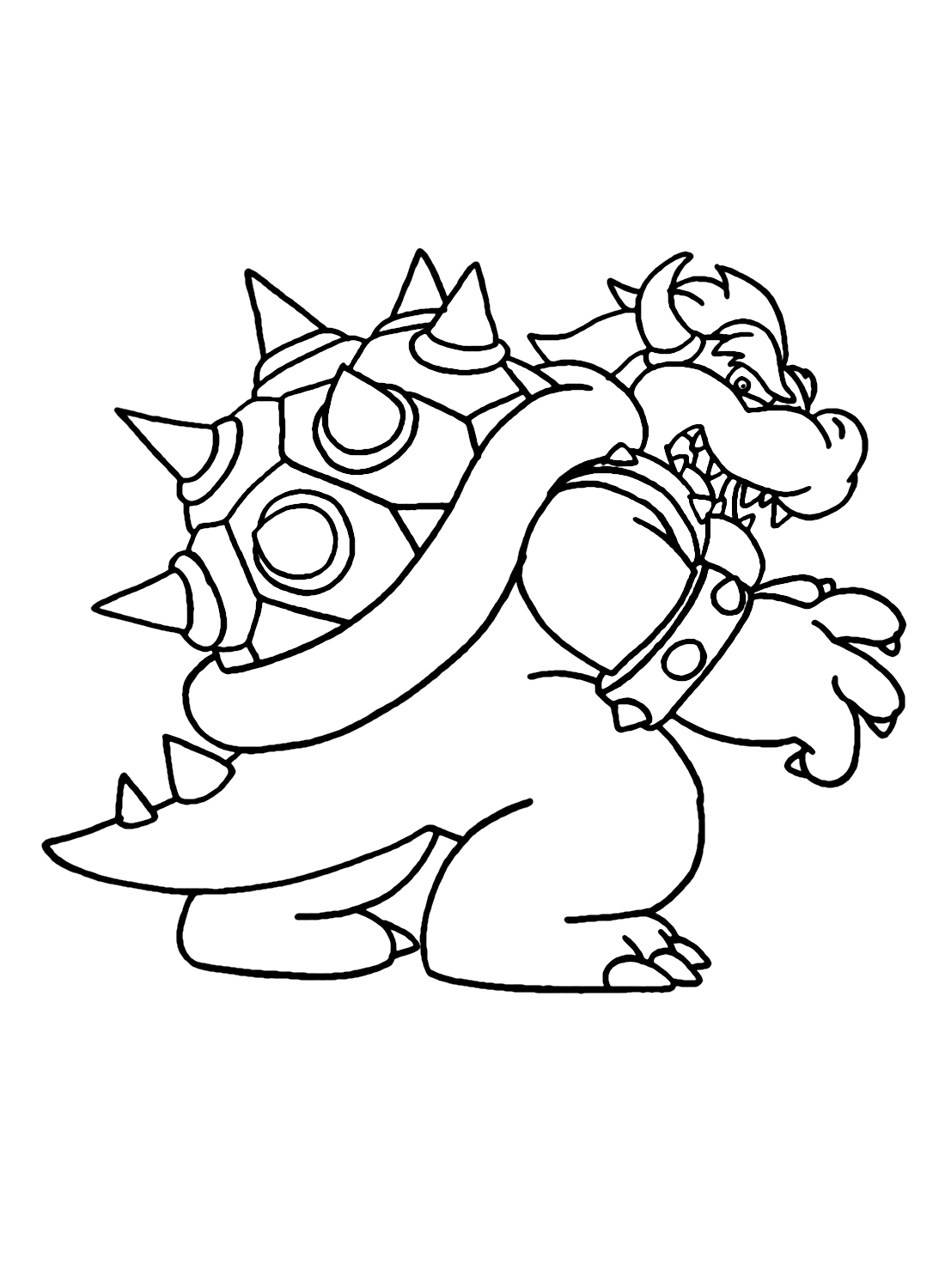
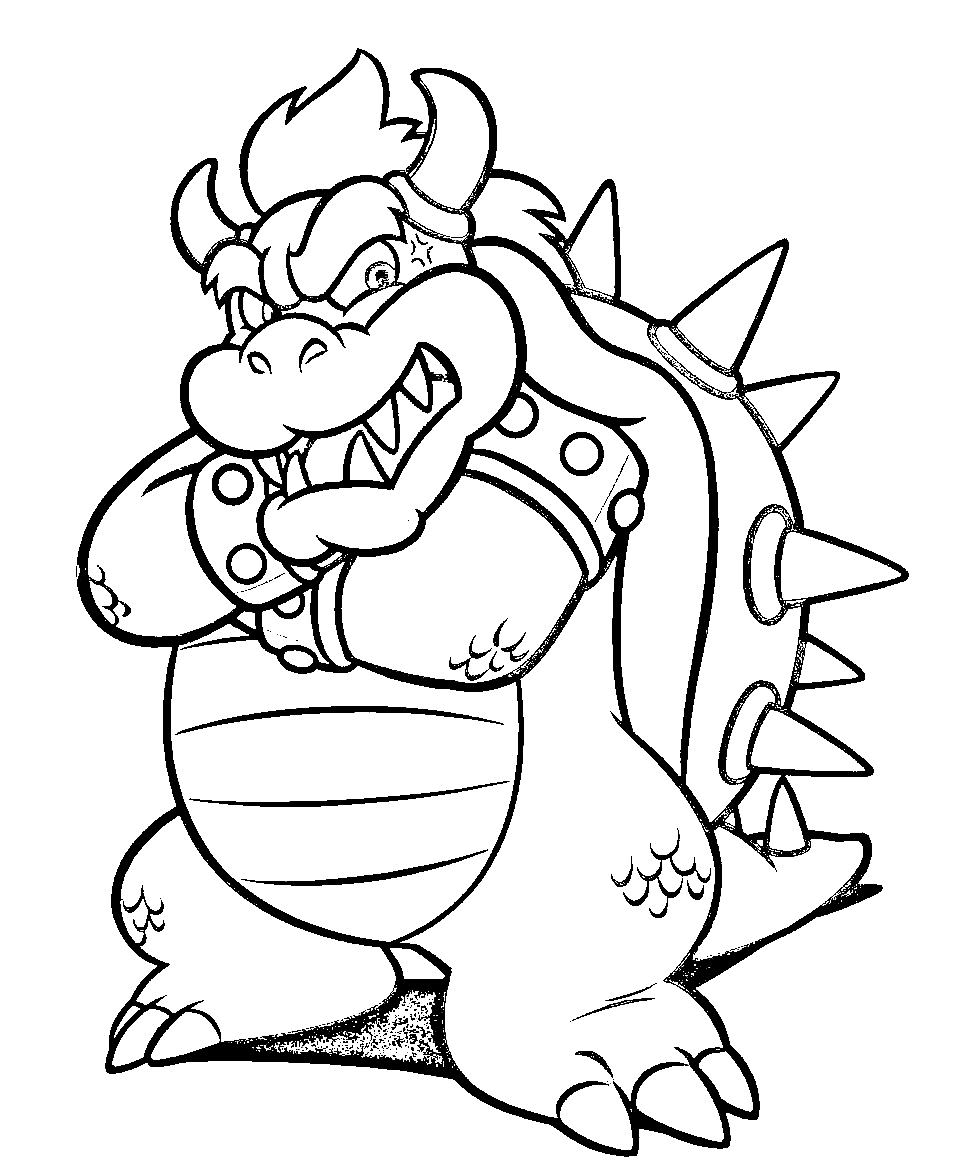
Bowser’s design is one of video game character art’s most specifically detailed and most consistently maintained visual identities across forty years of iterative game design. The core elements have remained stable since the 1985 original: the green spiked shell, the yellow-orange scaly skin, the spiked collar and wristbands, the sharp horns and fangs, the red-orange hair and eyebrows, and the overall impression of massive, self-assured physical power.
Each element of the design communicates something specific about the character. The shell, originally associated with protection (the Koopa Troopas that populate Mario’s world hide in their shells when attacked), is here transformed into a display of offensive threat: Bowser’s shell spikes are weapons, not refuges. The spiked collar and wristbands reference both medieval armor and the visual language of menacing authority. The red-orange hair and eyebrows provide the design’s warmest, most vivid color accent, giving the otherwise green-and-yellow design a hot, fiery energy that connects to his fire-breathing capability.
His proportions have evolved significantly across games: the relatively compact design of early 8-bit and 16-bit games has given way, particularly since Super Mario 64 (1996) and the subsequent 3D era games, to a larger, more muscular figure with a more elaborately detailed shell, more pronounced facial features, and the specific imposing scale that his role as the franchise’s primary antagonist requires.
Coloring classic Bowser pages: The shell is the composition’s most structurally complex element: a green that leans slightly toward olive-green rather than vivid grass-green, applied at full coverage across all shell plates. The spikes protruding from the shell’s ridgeline are white or pale ivory with slightly darker grey tips, applied carefully at each spike position. The spiked collar and wristbands are the same white ivory with the same grey-tipped spike treatment. His skin is warm yellow-orange, the specific warm tone between yellow and orange that reads as scaly and reptilian. His eyes are red with dark pupils. His hair and eyebrows are the most vivid warm red-orange in the composition.
Fire-Breathing Pages
Bowser breathing fire is the collection’s most visually dynamic category and the action most consistently associated with him across four decades of games, animation, and film. In the original Super Mario Bros. (1985), Bowser’s fire was represented as a simple projectile in the limited pixels of the NES. In subsequent 3D games, it became an elaborate stream of orange-yellow flames projected from his open mouth. In the 2023 Illumination film, his fire-breathing was rendered with the full visual complexity of high-end CGI animation: a column of fire with core temperatures, visible heat distortion, and the specific physical behavior of propelled combustion.
The fire-breathing pages are the collection’s most demanding coloring challenge and most rewarding when completed: the combination of Bowser’s warm skin tones and the vivid orange-yellow flame creates a composition dominated by the warm end of the color spectrum, with the green shell providing the single cool-color counterpoint.
Coloring fire-breathing pages: The flame requires careful gradient application. The hottest point of the flame, at the center of the stream closest to Bowser’s mouth, is near-white or pale yellow-white: this is the hottest part of the combustion where visible light is closest to white. The main body of the flame is vivid orange-yellow, the specific saturated warm orange of a large bonfire. The outer edges of the flame, where the combustion mixes with cooler surrounding air, are a deeper orange-red. Apply these three zones from the center outward: white-yellow core, vivid orange-yellow main body, orange-red outer edges. Any heat distortion effects around the flame should be applied as very faint warm yellow lines at minimum pressure around the flame’s perimeter.
Bowser Jr.: The Son Pages
Bowser Jr. first appeared in Super Mario Sunshine, released July 19, 2002, in Japan and August 26, 200,2 in North America for the Nintendo GameCube. He is Bowser’s son, sharing his father’s reptilian Koopa design but in a younger, smaller, less imposing form. His most distinctive visual feature is his signature white cloth bib/bandana tied around his neck, upon which a crude mouth with jagged teeth has been drawn: in Sunshine, he uses this bandana to impersonate Princess Peach. His other distinguishing feature is a small topknot of orange-red hair rising from the center of his head.
His shell is smaller and lighter than Bowser’s: the same green family but in a smaller, rounder form. His skin uses the same warm yellow-orange as his father’s, and his eyes share the same red quality, but the overall proportions are the younger, rounder proportions of a child character.
His Koopa Clown Car, the flying clown-head-shaped vehicle he uses throughout the games, is a pink or white spherical vehicle with a red clown-nose, large round eyes, and small helicopter rotors, designed to look like a cartoonish clown face.
Coloring Bowser Jr. pages: His shell and skin use the same color family as Bowser’s, but at slightly lighter values, suggesting youth. The white bandana with its drawn-on mouth is clean white with dark grey or black lines for the mouth drawing. The small topknot is the same warm red-orange as Bowser’s hair. His Koopa Clown Car, if visible, is pale pink or white as the primary body color with bright red for the nose element and vivid yellow for any star or decorative elements.
Dry Bowser: The Skeletal Form
Dry Bowser first appeared in New Super Mario Bros., released May 15, 2006, in Japan and May 14, 2006, in North America for the Nintendo DS. He is a skeletal version of Bowser: when Bowser falls into lava, his flesh burns away, leaving only the bones behind in a form that still functions as an enemy. In some games, Dry Bowser is simply a skeleton enemy that Mario fights; in others, he is Bowser himself temporarily reduced to skeletal form before regenerating.
His design is the collection’s most dramatically different from the canonical living Bowser: instead of the warm yellow-orange skin, the design shows exposed bones in warm off-white or pale grey-white, with the shell remaining attached. The head is a skull with the characteristic horn positions, the jaw showing bare teeth rather than Bowser’s fangs in flesh, and the eye sockets showing red glowing eyes rather than the fleshed eyes of the living version.
Coloring Dry Bowser pages: The bone is the primary color: warm off-white or pale warm grey, applied across all skeletal surfaces. The shell maintains its green color (the shell is a hard material that survives the lava, unlike the flesh). The spiked collar and wristbands remain white as in the living version. The glowing eyes in the skull sockets are vivid red at the center of each socket, fading to orange-red at the edges of the glow. Any remaining dark areas within the skeleton (the interior of the jaw, deep shadow areas between bone segments) use very dark warm grey or near-black.
Fury Bowser: The Giant Dark Form
Fury Bowser is the large antagonist form that appears in Super Mario 3D World + Bowser’s Fury, released February 12, 2021, for Nintendo Switch. In this form, Bowser has been overtaken by dark, ink-like energy that causes him to grow to an enormous size and behave as a force of destruction, attacking everything in the environment regardless of his normal motivations. He functions essentially as a kaiju: a naturally occurring disaster that periodically erupts and must be endured or confronted.
His design in this form is dramatically different from the canonical Bowser: his body is covered in a dark, liquid-looking black substance that appears to flow and drip. Only certain elements of his normal design are visible through the darkness: the glowing orange-yellow eyes, the shell’s spikes (now dark), and the fire that he breathes (now a deep dark purple or near-black rather than the warm orange of his normal flames).
Coloring Fury Bowser pages: The ink-dark covering is the primary color challenge: near-black or very dark blue-grey applied across the full body surface at maximum pressure. The shell spikes and collar elements are slightly lighter, dark grey, distinguishable from the surrounding darkness but still very dark overall. The eyes are the most vivid element: vivid orange-yellow against the dark surrounding face, the only warm color in the composition. Any dark fire effects use deep purple-blue rather than the warm orange of normal Bowser fire.
Bowser in the 2023 Film
The Illumination animated film The Super Mario Bros. Movie, released April 5, 2023, in the United States, featured Jack Black as the voice of Bowser. The film’s Bowser is a visually elaborate CGI rendering of the canonical design: the green shell, the warm yellow-orange skin, the red-orange hair, and the spiked collar and wristbands, all rendered with the visual complexity of high-end modern animation.
Jack Black’s performance as Bowser introduced a new dimension to the character: his musical number “Peaches” (a tender love ballad that Bowser performs on a grand piano in his castle while his Koopa army watches) showed a character capable of genuine romantic feeling expressed through dramatic musical theater. “Peaches” was written by Jack Black and received a nomination for the Academy Award for Best Original Song at the 96th Academy Awards ceremony held on March 10, 2024.
The film’s Bowser also served as the franchise’s most narratively developed villain to that point: his kidnapping of Princess Peach is explicitly motivated by his genuine feelings for her and his desire to protect what he loves, adding a layer of emotional complexity to a character who had been primarily defined by pure antagonism across four decades of games.
Coloring film-style Bowser pages: The film’s rendering maintains all canonical colors but with the three-dimensional quality of CGI: slightly more complex value variation within the green shell (lighter at the raised spine ridges, darker in the recessed areas between plates), slightly more warmth variation in the skin (lighter on the belly and inner arm surfaces, warmer and slightly darker on the outer surfaces), and more elaborate detail in the spiked collar’s individual spike forms.
What These Pages Do
Bowser occupies a specific and well-documented position in video game cultural history as one of the medium’s first established recurring antagonists: a villain who appears consistently across multiple games, whose visual identity becomes as recognizable as the hero’s, and whose presence structures the player’s expectations before any game begins. His forty years of appearances across hundreds of Nintendo games have made him one of the most globally recognized fictional characters created in Japan, alongside his franchise’s protagonist Mario and Pikachu.
The specific design choice that gives Bowser his enduring visual power is the combination of opposing symbolic registers: the turtle’s shell (associated with slow movement, defensive retreat, and protection) combined with the dragon’s characteristics (fire-breathing, aggressive, massive, commanding) produces a character who synthesizes natural and mythological threat into a coherent single figure. This design contradiction is the source of both his comedic possibilities (his genuine feelings for Peach, his loving relationship with Bowser Jr., his occasional alliances with Mario against greater threats) and his intimidating qualities.
The American Academy of Pediatrics identifies fine motor skill development as a key childhood milestone throughout early childhood. The shell’s spiked ridge pattern, the individual spike rendering on the collar and wristbands, the fire-breathing flame gradient work, the Dry Bowser bone structure rendering, and the Fury Bowser’s dark ink texture all provide sustained fine motor challenge calibrated to the collection’s wide age range. The 2005 Art Therapy Journal study on structured coloring and anxiety reduction applies throughout.
The “Peaches” song from the 2023 film, which received an Academy Award nomination, represents a specific cultural moment in which a video game character’s villain was humanized through musical expression in a way that expanded the franchise’s emotional range for a new generation of viewers.
How to Color These Pages Well
The shell green requires the specific olive-green of Bowser’s design rather than bright grass-green. The most common error on Bowser shell pages is applying a vivid, bright green that reads as lime or grass color. Bowser’s shell green is a slightly darker, slightly more yellow-shifted olive-green that reads as reptilian and natural rather than vivid and artificial. Apply it at full coverage across all shell plates. If the available green reads as too vivid or too blue, add a small amount of yellow-olive over it to shift it toward the correct tone.
The warm skin color manages the design’s most complex color zone. Bowser’s skin is yellow-orange, but the specific tone varies between his belly (lighter, more yellow), his outer limb surfaces (warmer and slightly more orange), and the deepest shadow areas (slightly more orange-brown). Apply the base warm yellow-orange across all skin surfaces first. Then add a slightly more orange and slightly deeper tone on the outer arm and leg surfaces. The belly, if visible, can be left at the base tone or slightly lightened with a pale yellow layer applied at minimum pressure.
The shell spikes and collar spikes use the three-zone spike technique. Each spike on Bowser’s shell ridgeline, collar, and wristbands follows the same form: widest at the base, tapering to a sharp point at the tip. Apply the base white or pale ivory across the full spike from base to tip. Then add slightly darker warm grey along the shadow side of each spike (typically the left or right side, depending on the light source direction). The very tip of each spike is the sharpest element and should be the slightly darkest point: apply a small amount of the shadow grey at the extreme tip to give it visual definition.
Red eyes against dark or complex face features require precise placement. Bowser’s red eyes are the face’s most vivid color element and the points from which the character’s intensity reads most directly. Apply the vivid red within the eye outline at full saturation. The dark pupil in the center creates the specific focused-aggression expression of the character. In Dry Bowser pages, the eyes are glowing points within empty skull sockets: apply the vivid red at the center of each socket and add a very subtle orange-red glow effect around the rim.
Fire effects require the center-to-edge gradient applied in sequence. Always begin the flame gradient from the hottest, lightest central core and work outward toward the cooler, darker outer edge. Apply near-white or pale yellow-white at the absolute center of the flame stream. Apply the main vivid orange-yellow over and around that core. Apply the outer orange-red at the flame’s farthest edges. Working from inside out prevents the deeper colors from contaminating the central glow point, which must remain visibly brighter than everything surrounding it.
5 Creative Craft Ideas
The Forty-Year Design Evolution
Bowser appeared in 1985 as a relatively simple sprite on the NES and has been redesigned progressively through the 3D era, multiple art style evolutions, and the 2023 Illumination film. Print pages representing three distinct visual eras: a simple, blocky design referencing the classic 8-bit era, a more detailed design from the 3D game era (post-1996), and the film-style design from 2023.
Color all three using consistent canonical colors: olive-green shell, warm yellow-orange skin, red-orange hair, and white spiked collar. The colors remain consistent across forty years of design evolution; only the detail and proportions change.
Mount in chronological order: “Bowser. Designed in 1985. Nintendo Famicom/NES. Super Mario Bros., September 13, 1985. 40 years in continuous production. The design has been refined. The shell, the spikes, the collar, the fire: unchanged.”
The “Peaches” Song Tribute
Jack Black’s performance as Bowser in the 2023 Illumination animated film included “Peaches,” a musical number in which Bowser performs a tender ballad about his feelings for Princess Peach at a grand piano in his castle. The song was nominated for the Academy Award for Best Original Song at the 96th Academy Awards, held March 10, 2024.
Print the most theatrically posed Bowser page in the collection: one showing him in a dramatic or expressive stance rather than a combat pose. Color in full canonical colors.
On the backing card: “Peaches. Written by Jack Black. Performed by Jack Black as Bowser in The Super Mario Bros. Movie, 2023. Academy Award nomination: Best Original Song, 96th Academy Awards, March 10, 2024. The Super Mario Bros. Movie worldwide gross: $1.362 billion. The villain performed a love song about Princess Peach at a piano while his entire army watched in silence. This is canonical.”
The Villain Who Sometimes Helps
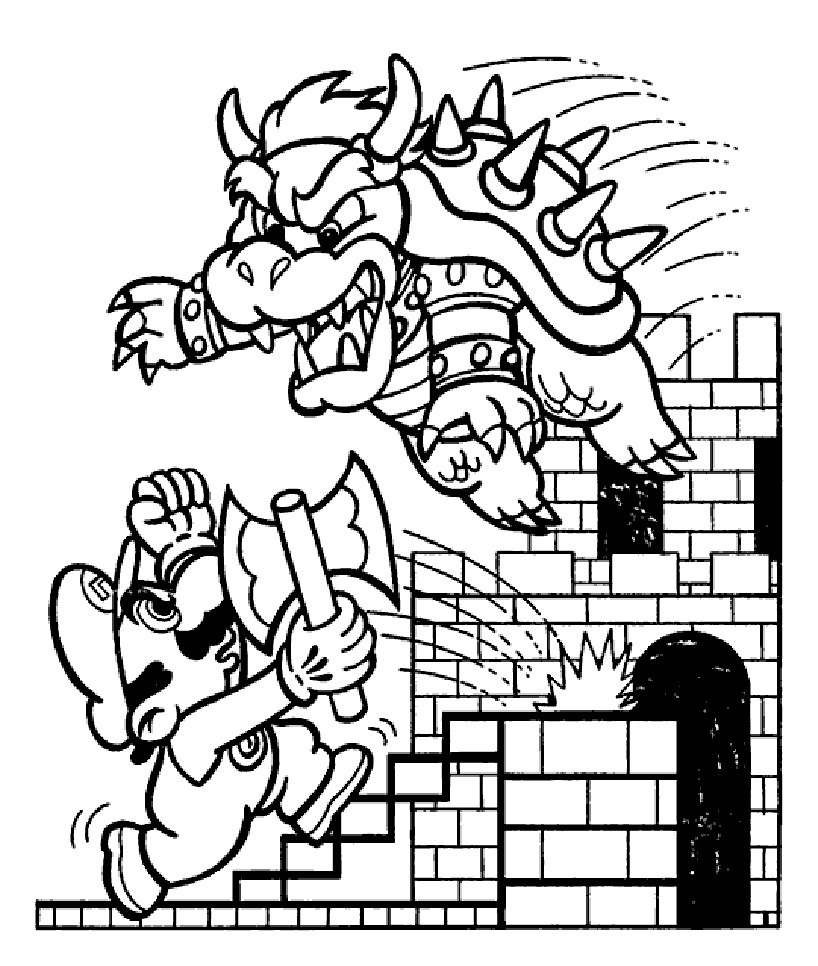
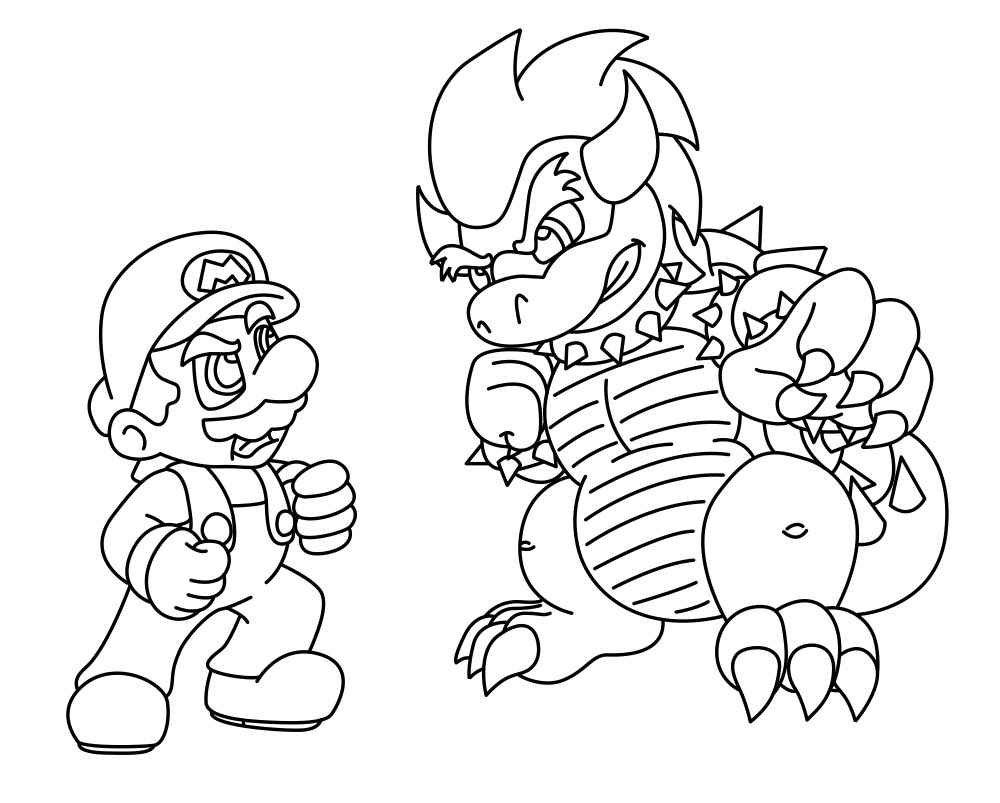
Bowser’s relationship with Mario is defined primarily by antagonism but has included documented moments of alliance: in Super Paper Mario (2007), both characters work together against a greater threat; in Super Mario RPG: Legend of the Seven Stars (1996), Bowser is a playable party member; in Mario & Luigi: Bowser’s Inside Story (2009), Bowser is the primary playable character and must be saved.
Print one Bowser page and one Mario page (or any other ally character). Color both in their canonical designs.
Mount them side by side: “Bowser, the primary antagonist of the Super Mario franchise since September 13, 1985. First appeared: Super Mario Bros. Occupation: kidnapping Princess Peach, ruling the Koopa Kingdom. Number of appearances with Mario as an ally: at least 4 documented major games. The alliance is always temporary. The antagonism is permanent. Both remain true.”
The Dry Bowser Anatomy Study
Dry Bowser, first appearing in New Super Mario Bros. (2006), is the skeletal version of Bowser produced when Bowser falls into lava. The design shows which elements of Bowser’s design are biological (skin, flesh: burned away by lava) and which are structural (shell, spikes, collar: remaining intact as hard material).
Print one Dry Bowser page. Color the skeletal elements in warm pale grey-white bone tone. Color the shell in the same olive-green as the living version, confirming that the shell survives lava. Apply vivid red to the glowing eyes in the skull sockets.
Label the design elements: “Shell (green): survives. Hard material. Spikes: survive. Hard material. Collar: survives. Hard material. Skin and flesh: does not survive. Lava burns away the biological material. What remains: the structure. First appearance: New Super Mario Bros., Nintendo DS, May 15, 2006.”
The Koopa Kingdom Display
Bowser rules a kingdom: the Koopa Kingdom, also called Bowser’s Kingdom or Dark Land, depending on the game. His subjects include Koopa Troopas, Goombas, Bob-ombs, Magikoopas, Bullet Bills, and dozens of other enemy types established across forty years of Super Mario games. His castle, a fire-filled fortress with lava moats, appears as the final challenge in most main-series Mario games.
Print a dramatic Bowser castle scene page or the most imposing Bowser standing portrait. Color in full canonical design.
On the backing card, draw a simple kingdom map: “The Koopa Kingdom. Ruler: Bowser, King of the Koopas. Territory: Dark Land. Capital: Bowser’s Castle. Notable features: lava moats, fire traps, and Bowser’s throne room. Known subjects: Koopa Troopas, Goombas, Bob-ombs, Magikoopas, Bullet Bills, Hammer Bros, Boo. Population: very large. The kingdom has been conquered by Mario multiple times. Bowser has rebuilt each time. This is consistent with the character.”
Frequently Asked Questions
Who is Bowser, and when did he first appear? Bowser (クッパ, Koopa in Japanese) is the primary recurring antagonist of Nintendo’s Super Mario franchise, first appearing in Super Mario Bros., released in Japan on September 13, 198,5 and in North America on October 18, 19,85 for the Nintendo Entertainment System. He was created by Shigeru Miyamoto and Takashi Tezuka, with character design developed by Yoichi Kotabe. Bowser is the King of the Koopas, ruler of the Koopa Kingdom, and the recurring antagonist who repeatedly kidnaps Princess Peach across forty years of games, forcing Mario to rescue her. His design is a large, bipedal turtle-dragon hybrid: a green spiked shell, warm yellow-orange scaly skin, red-orange hair, horns, sharp fangs, and spiked collar and wristbands that communicate his role as a threatening ruler.
What are Bowser’s primary visual design elements, and how should they be colored? Bowser’s design consists of five primary visual elements that have remained stable across forty years. His shell is olive-green, slightly darker and more yellow-shifted than vivid grass-green, with white spiked ridges running along the top. His skin is warm yellow-orange, the specific tone of warm reptilian scales. His hair and eyebrows are vivid red-orange, the design’s hottest color accent. His spiked collar and wristbands are white or pale ivory with grey-tipped spikes. His eyes are red with dark pupils. These five elements, applied at their correct specific tones rather than generic approximations, are what make a Bowser page read as Bowser specifically rather than as a generic turtle-dragon character.
What is Bowser’s relationship with Bowser Jr.? Bowser Jr. is Bowser’s son, introduced in Super Mario Sunshine, released July 19, 2002, in Japan and August 26, 200,2 in North America for the Nintendo GameCube. The identity of Bowser Jr.’s mother has never been officially confirmed in any Nintendo game. Bowser Jr. shares his father’s general Koopa design but in a smaller, younger form with a distinctive white bandana with a drawn-on toothy grin, a small topknot of orange-red hair, and a smaller, lighter shell. In Super Mario Sunshine, Bowser Jr. impersonates Princess Peach using the bandana to conceal his face. The father-son relationship between Bowser and Bowser Jr. is one of the franchise’s most consistently warm emotional threads: Bowser is genuinely loving and protective toward his son across multiple games.
What is Dry Bowser? Dry Bowser is the skeletal form of Bowser that appears in several Mario games beginning with New Super Mario Bros. for the Nintendo DS, released May 15, 2006. He is the result of Bowser falling into lava: the biological flesh burns away, leaving behind the structural elements (the shell, the spiked collar, and wristbands) and an animated skeleton with glowing red eyes in the skull sockets. In some games, Dry Bowser is Bowser in a temporary state; in others,s he is a separate character or enemy type. His design reverses the warm color palette of the living Bowser: the skin is replaced by pale bone, and only the shell’s green and the glowing red eyes retain vivid color against the surrounding pale grey-white of the skeleton.
What is Fury Bowser, and where does it appear? Fury Bowser is a transformed version of Bowser that appears as the primary antagonist of the Bowser’s Fury portion of Super Mario 3D World + Bowser’s Fury, released February 12, 2021, for Nintendo Switch. In this game, Bowser has been overtaken by a dark, ink-like energy source that transforms him into a massive, destructive form many times larger than his normal size. Fury Bowser behaves as a natural disaster rather than as a conscious villain: he periodically erupts from the sea and attacks everything in the environment indiscriminately. His design is dramatically different from canonical Bowser: his body is covered in dark, flowing ink-like energy, his fire is deep purple rather than warm orange, and his overall appearance suggests a threat beyond the conscious intentions of the normal character.
What is the 2023 Super Mario Bros. Movie,e and how was Bowser portrayed? The Super Mario Bros. Movie is an animated film produced by Illumination (Universal Pictures) in collaboration with Nintendo, directed by Aaron Horvath and Michael Jelenic, and released on April 5, 2023, in the United States. It earned $1.362 billion worldwide, making it the highest-grossing video game film adaptation in history at the time of its release. Jack Black voiced Bowser and performed “Peaches,” a love ballad that Bowser sings about his feelings for Princess Peach while playing piano in his castle. “Peaches” was nominated for the Academy Award for Best Original Song at the 96th Academy Awards on March 10, 2024. Jack Black’s portrayal of Bowser was widely praised for combining genuine menace with comedic emotional honesty, adding narrative depth to a character who had been primarily defined as a straightforward antagonist across four decades of games.
What are the Koopalings, and how do they relate to Bowser? The Koopalings are seven characters first introduced in Super Mario Bros. 3 (1988) who were initially presented as Bowser’s children: Larry Koopa, Morton Koopa Jr., Wendy O. Koopa, Iggy Koopa, Roy Koopa, Lemmy Koopa, and Ludwig von Koopa. Following the introduction of Bowser Jr. in Super Mario Sunshine (2002), Nintendo clarified that the Koopalings are not Bowser’s biological children but rather his elite minions or “chosen ones” (official statement from Nintendo of America in 2012 specified they are not his children). Each Koopaling has a distinct design, color scheme, and personality that distinguishes them from each other and from Bowser Jr.
What age group are these pages best suited for? Bowser coloring pages serve Super Mario franchise fans across a wide age range. The simplest portrait pages with large, clearly defined color areas in the bold style of the franchise are accessible from ages four and five, where the character recognition and the strong primary color accents (the vivid red-orange hair against the shell’s green) provide immediately achievable and visually satisfying targets. The detailed pages with shell spike rendering, fire gradient effects, and Dry Bowser bone structure work are most rewarding from ages six to ten, where developing fine motor control allows for more careful application. The Fury Bowser dark-ink texture pages and the film-design detailed pages are most engaging for ages eight and up and for adult fans who have followed the franchise across multiple game generations.
Browse the full collection at ColoringPagesOnly.com. All 30+ pages free, no sign-up, PDF or PNG, print or color online.
Shigeru Miyamoto and Takashi Tezuka created a large, spiked-shell turtle-dragon king for a game about a plumber rescuing a princess in 1985. The game was released in Japan on September 13, 1985. It sold over 40 million copies.
Forty years later, the same character performed a love song at a piano in an animated film. The song was nominated for an Academy Award. The film earned $1.362 billion. The design: unchanged. The shell is still green. The collar is still spiked. The hair is still red-orange. The fire still comes from his mouth.
He has kidnapped Princess Peach many more times than can be accurately counted. He has been defeated each time. He has rebuilt each time. This is consistent with the character.
Pick up your olive-green for the shell. Apply at full coverage. Pick up your warm yellow-orange for the skin. Pick up your most vivid red-orange for the hair. The fire gradient goes center-out: white-yellow core, vivid orange body, dark red edges.
Share your work on Facebook and Pinterest and tag #Coloringpagesonly. The forty-year design evolution displays, and the Peaches song tribute pages are particularly worth sharing.
Color the shell green. Apply the spiked collar in white. The King of the Koopas has been here since 1985 and will not be leaving.