Most children gravitate toward computers, tablets, and game consoles, and many parents struggle to set limits on screen time without constant conflict. The American Academy of Pediatrics recommends no more than one hour of high-quality screen time per day for children ages 2 to 5, and consistent limits for school-age children that prioritize sleep, physical activity, and family time. Screens are not inherently harmful, but unstructured hours in front of a screen displace the play, conversation, and hands-on activity that young children need for healthy development.
The five activities below replace screen time with engagement that builds motor skills, language, patience, and family connection. None requires expensive equipment or special preparation. Each works for a range of ages, and several can be combined into a single afternoon. The goal is not to eliminate screens entirely but to build a daily rhythm where screen time is one option among many rather than the default.
1. Active Play
Physical play is the most direct replacement for sedentary screen time. Games like hide and seek, tag, building obstacle courses, or playing catch require no equipment and burn the physical energy that builds up during sedentary hours. The Centers for Disease Control and Prevention recommends that children ages 6 to 17 get at least 60 minutes of physical activity daily, and active play with a parent counts toward that target.
Beyond the physical benefit, play builds coordination, patience, and confidence. A child learning to catch a ball develops hand-eye coordination through repetition. A child inventing rules for a backyard game practices negotiation and creativity. The shared activity also strengthens the parent-child bond in a way that parallel screen time cannot replicate. Start with simple games the child already knows, then let the child invent variations.

2. Reading Together
Reading aloud is one of the most documented activities for early childhood development. Children who are read to regularly develop larger vocabularies, stronger listening comprehension, and earlier literacy skills than children who are not. The shared attention of reading together also builds the kind of focused, calm engagement that fast-paced screen content tends to undermine.
The delivery matters as much as the book. Reading with distinct character voices, pausing to ask what might happen next, and letting the child turn the pages keeps a young reader actively engaged rather than passively listening. For reluctant readers, pairing reading time with a small ritual — a specific cozy chair, a warm drink, a consistent bedtime slot — turns reading into an anticipated part of the daily routine rather than a chore. Picture books work for toddlers; chapter books read in installments work for older children.

3. Building a Fort
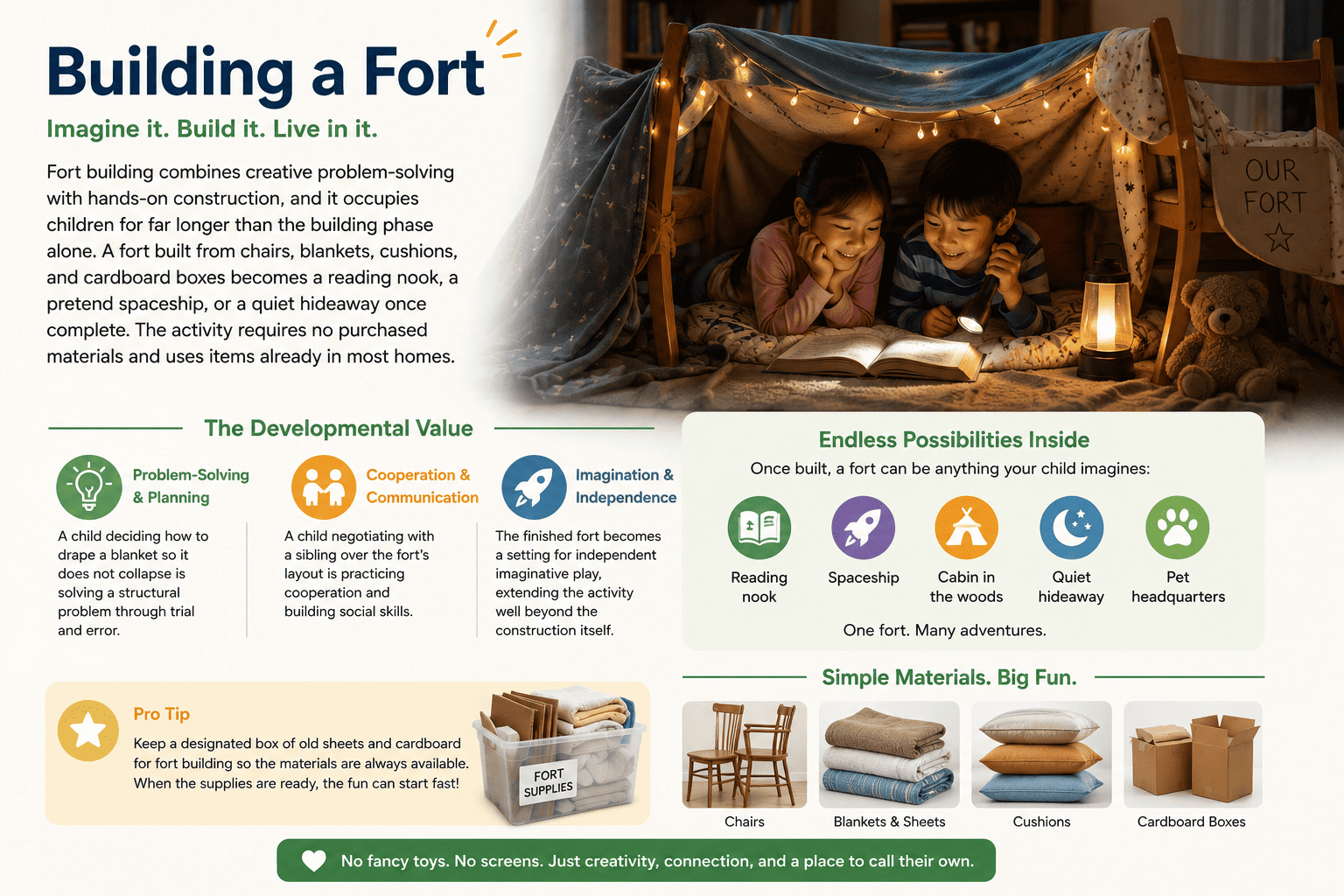
Fort building combines creative problem-solving with hands-on construction, and it occupies children for far longer than the building phase alone. A fort built from chairs, blankets, cushions, and cardboard boxes becomes a reading nook, a pretend spaceship, or a quiet hideaway once complete. The activity requires no purchased materials and uses items already in most homes.
The developmental value lies in the planning and adjustment. A child deciding how to drape a blanket so it does not collapse is solving a structural problem through trial and error. A child negotiating with a sibling over the fort’s layout is practicing cooperation. The finished fort then becomes a setting for independent imaginative play, extending the activity well beyond the construction itself. Keep a designated box of old sheets and cardboard for fort building so the materials are always available.
4. Cooking Together
Cooking turns an everyday necessity into a learning activity that covers math, reading, science, and motor skills at once. Measuring ingredients introduces fractions and volume. Following a recipe builds reading comprehension and sequencing. Watching batter rise or chocolate melt, demonstrates basic chemistry. For younger children, simple tasks like stirring, pouring pre-measured ingredients, or arranging toppings build fine motor control and a sense of contribution.
Choose recipes matched to the child’s age and attention span — no-bake recipes, simple cookies, or assembling pizzas work well for first attempts. Letting the child choose the recipe from a few options builds investment in the outcome. The shared work of preparing food, and then eating something the child helped make provides both the bonding benefit of a joint activity and the practical life skill of basic food preparation. Aprons and a step stool make the kitchen accessible and signal that cooking is the child’s activity too.

5. Coloring
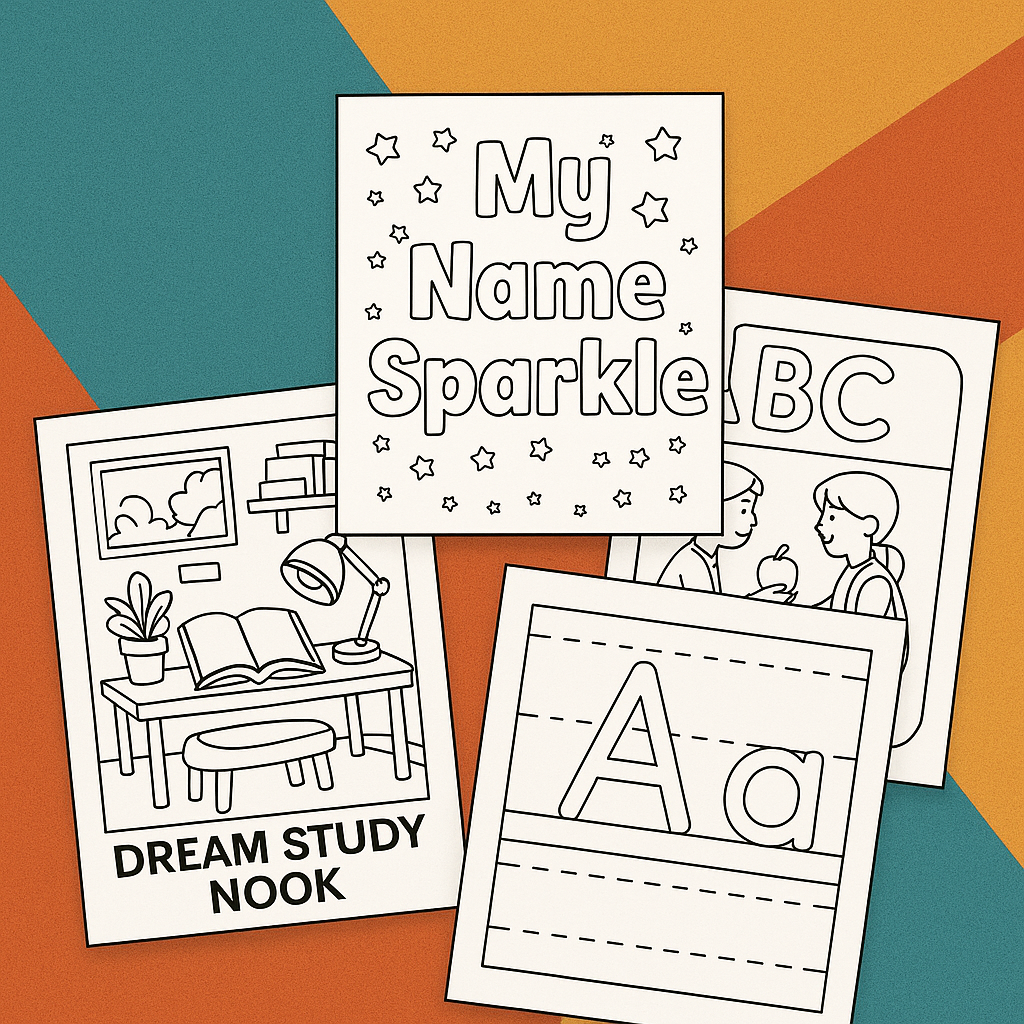
Coloring is a structured, screen-free activity that delivers documented developmental benefits across a wide age range. The American Academy of Pediatrics identifies fine motor skill development as a core benefit of structured coloring for children ages 2 through 7, building the pencil grip and hand control that later support handwriting. The defined boundaries of a coloring page give children a clear task with a visible sense of completion, which builds focus and patience.
Coloring also has a documented calming effect. A 2005 study in the Art Therapy Journal found measurable reductions in anxiety following structured coloring sessions, making coloring a useful wind-down activity after high-energy screen time or before bed. Unlike open-ended drawing, a printable coloring page removes the intimidation of a blank sheet and lets children focus on color choices and technique. Free printable coloring pages cover thousands of subjects, so a child interested in dinosaurs, vehicles, or a favorite character can color something they already care about, which sustains engagement far longer than a generic worksheet.

FAQ
Q1: How much screen time is appropriate for children?
The American Academy of Pediatrics recommends no screen time other than video chatting for children under 18 months, limited high-quality programming with a caregiver for ages 18 to 24 months, no more than one hour per day for ages 2 to 5, and consistent limits for ages 6 and up that do not displace sleep, physical activity, or other healthy behaviors. The specific limit matters less than ensuring screens do not crowd out the activities children need.
Q2: My child resists every screen-free activity. What can I do?
Start with activities tied to an existing interest rather than imposing an unfamiliar one. A child who loves a particular show might enjoy coloring pages of those characters or cooking a food featured in it. Begin with short sessions and join the activity rather than directing from a distance. Children resist transitions more than activities, so a five-minute warning before screen time ends reduces conflict.
Q3: At what age is it best to start these activities?
All five activities scale across ages. Active play, reading aloud, and coloring work from toddler age with simplified versions. Fort building and cooking suit ages 3 and up, with close supervision, becoming more independent as children develop. The activities grow with the child — a toddler stirs batter while an eight-year-old reads and follows the full recipe.
Q4: How long should a screen-free activity last?
Match the duration to the child’s age and attention span rather than a fixed target. A toddler may engage with coloring for ten minutes; a school-age child may build a fort for an hour. Forcing an activity past a child’s natural attention span creates negative associations. Ending while the child is still engaged makes them more likely to return to the activity willingly.
Q5: Are these activities a replacement for all screen time?
The goal is balance, not elimination. Screens have educational and social value when used in moderation. These activities ensure screen time is one option among several rather than the default that fills every unstructured hour. A daily rhythm that includes physical play, reading, hands-on activity, and limited screen time supports healthy development better than a strict screen ban.
Q6: Which activity works best for calming an overstimulated child?
Coloring and reading together are the most effective wind-down activities. Both involve focused, low-stimulation engagement that contrasts with the fast pace of most screen content. The 2005 Art Therapy Journal findings on coloring and anxiety reduction make coloring particularly useful after high-energy periods or as part of a bedtime routine.
CTA
Free printable coloring pages are available across thousands of subjects at no cost — no account required. Print pages directly from the browser or color online. Pair coloring with the other activities above to build a daily rhythm where screen time is one choice among many.