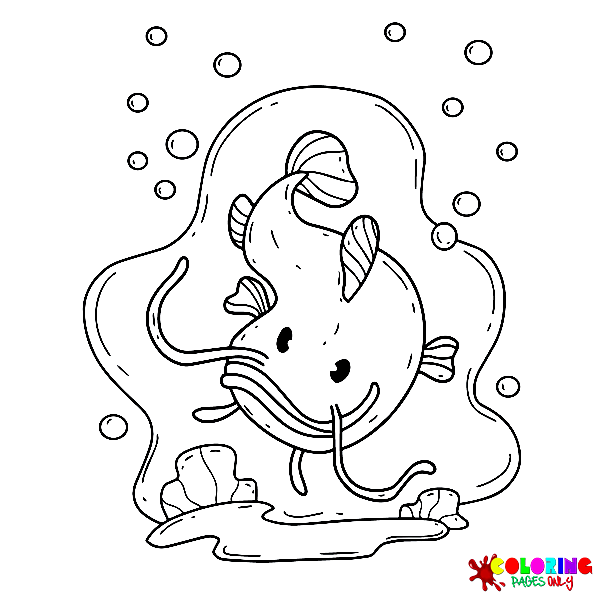
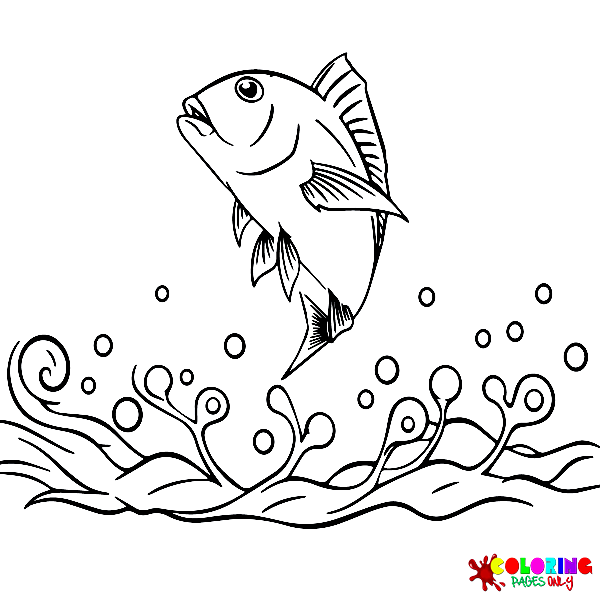
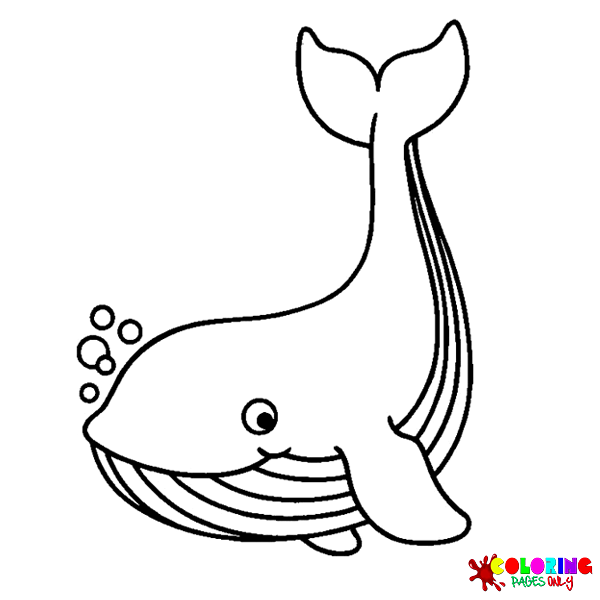
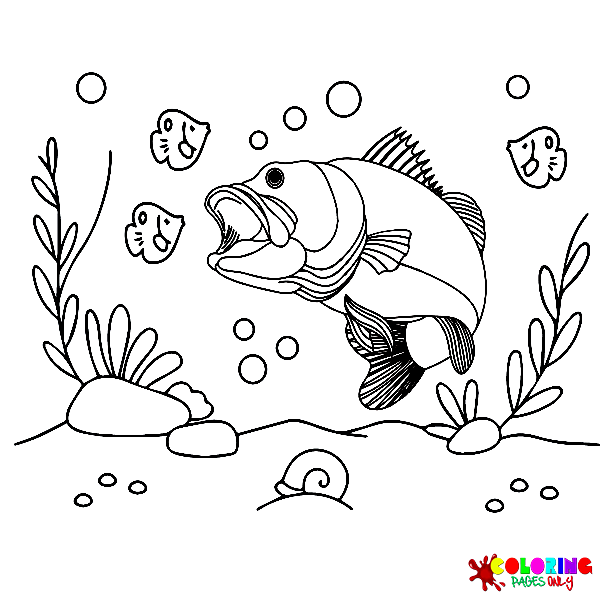
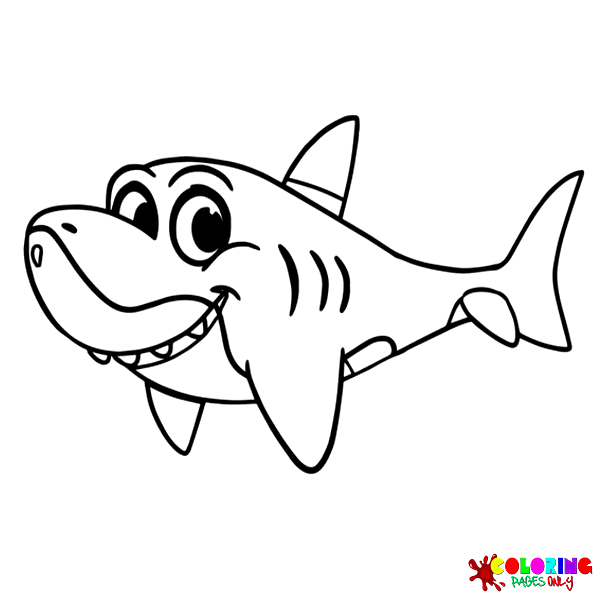
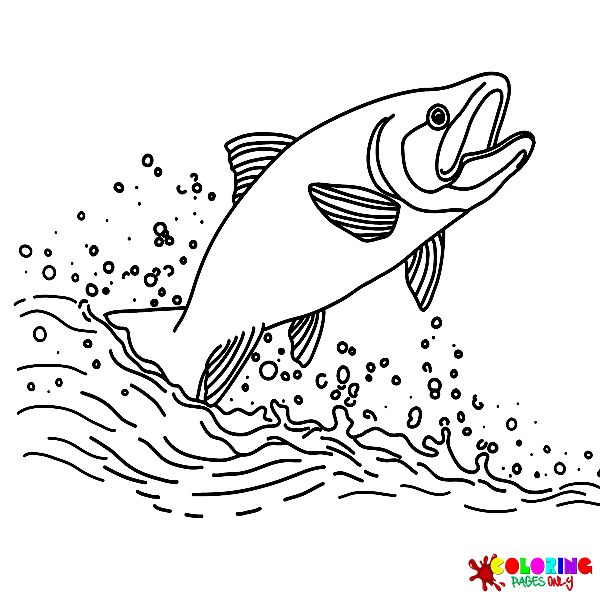
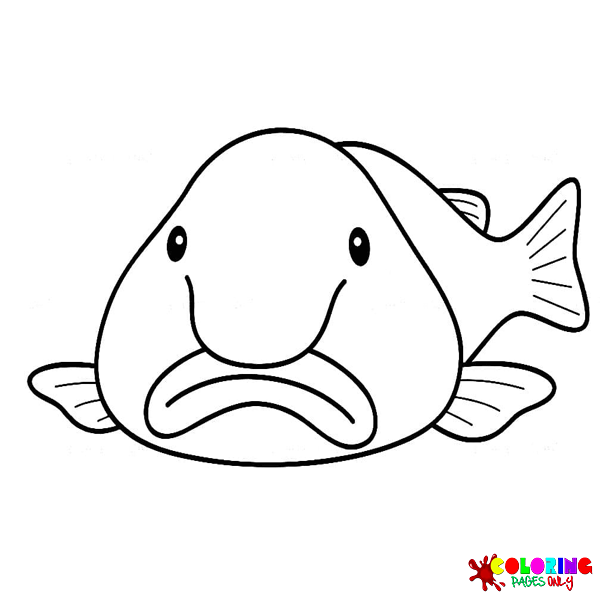
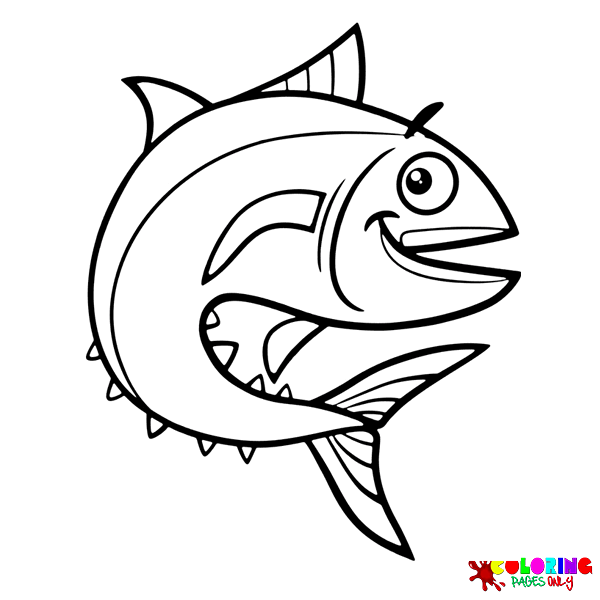
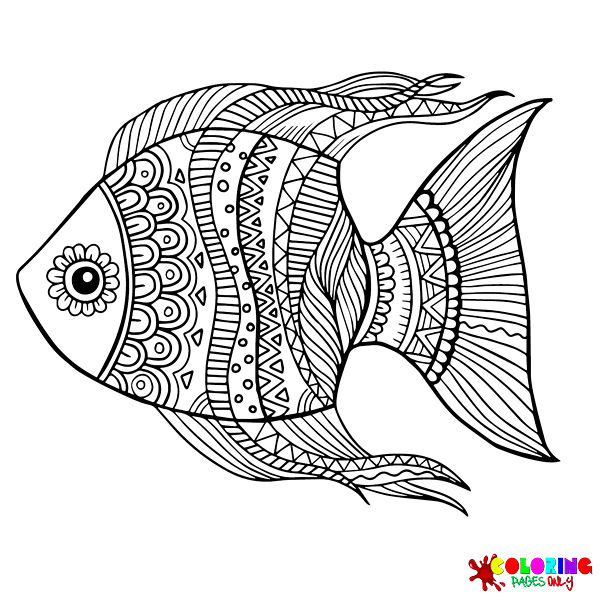
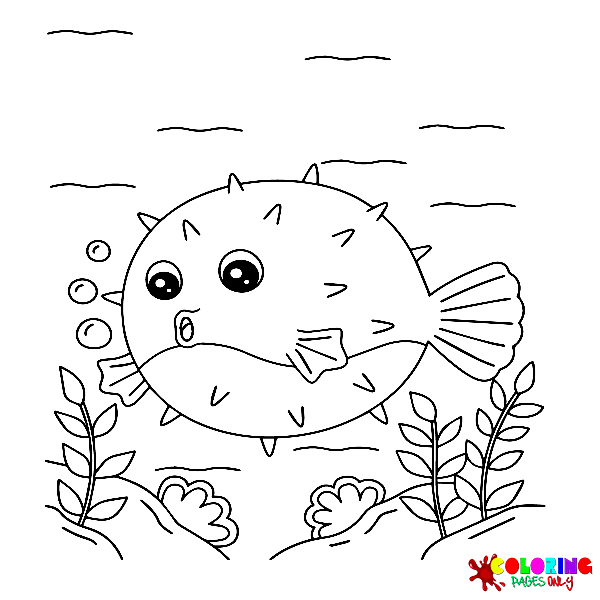
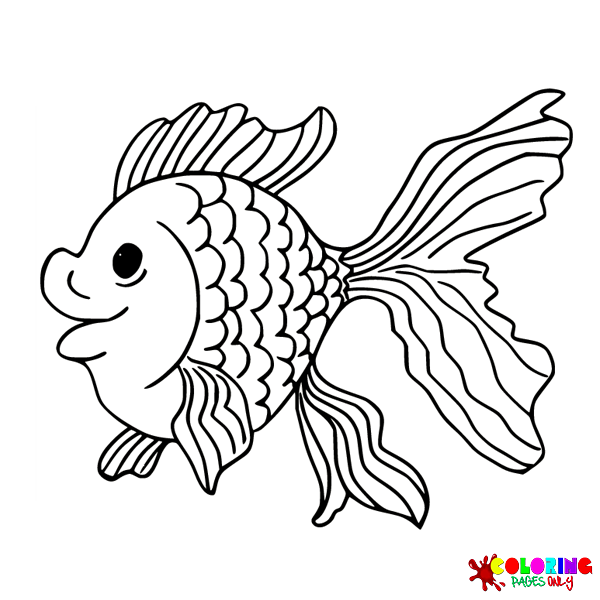
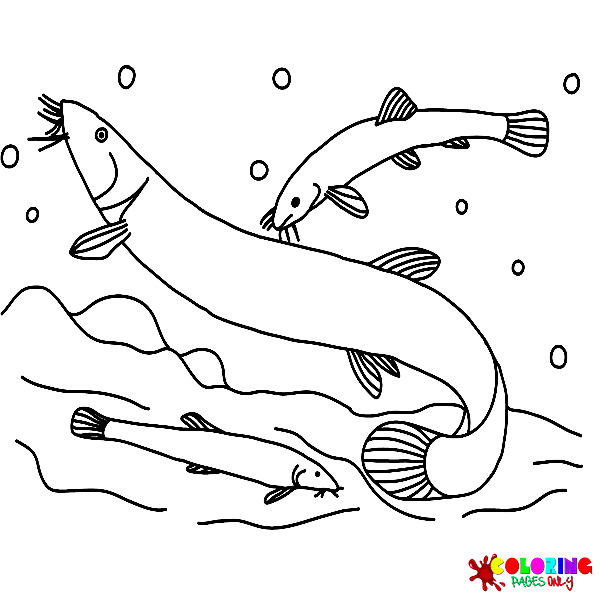
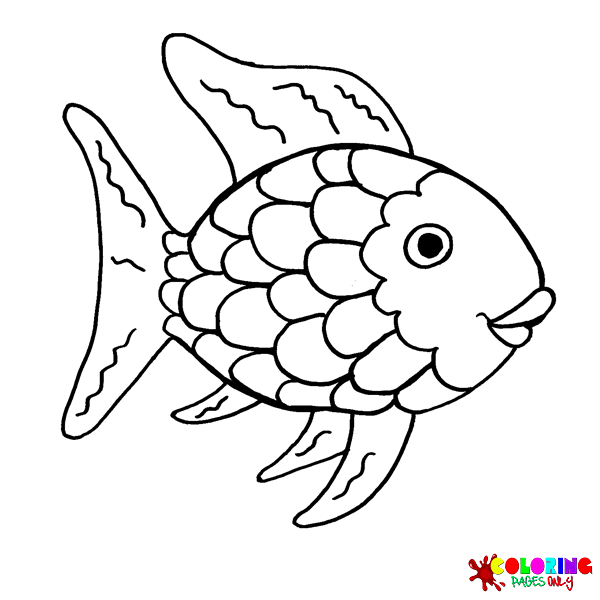
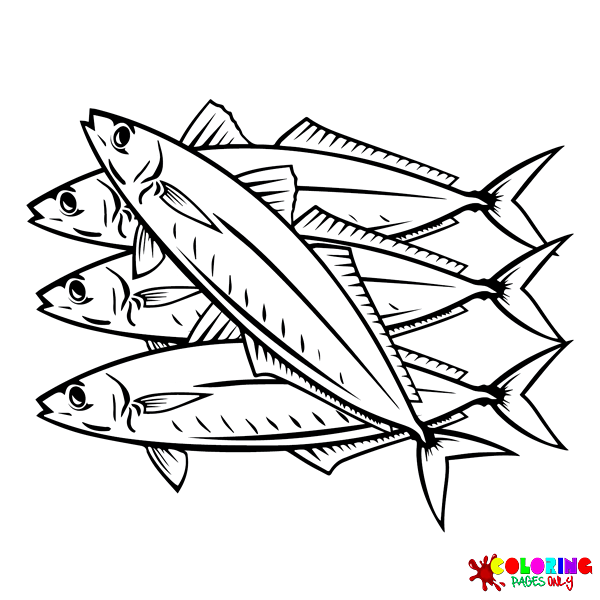
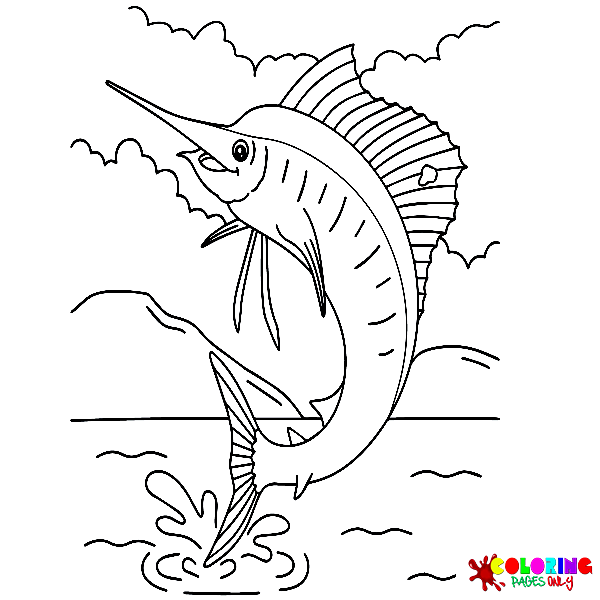
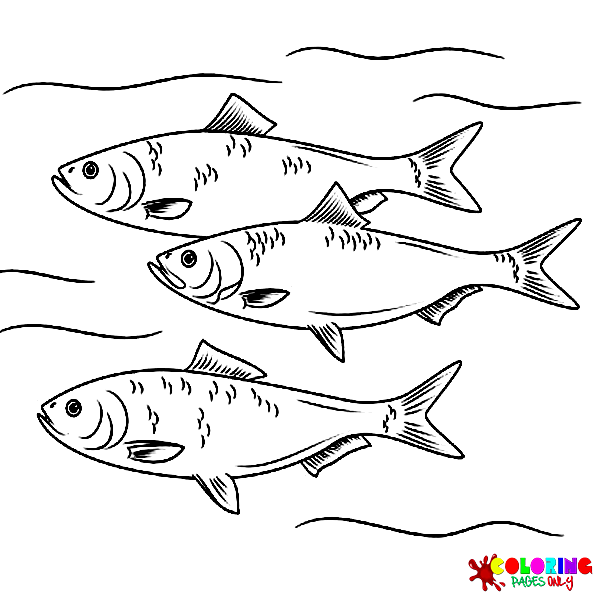
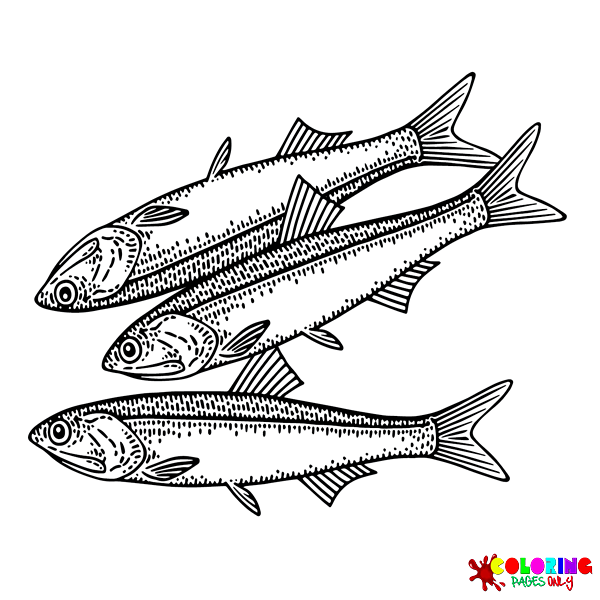
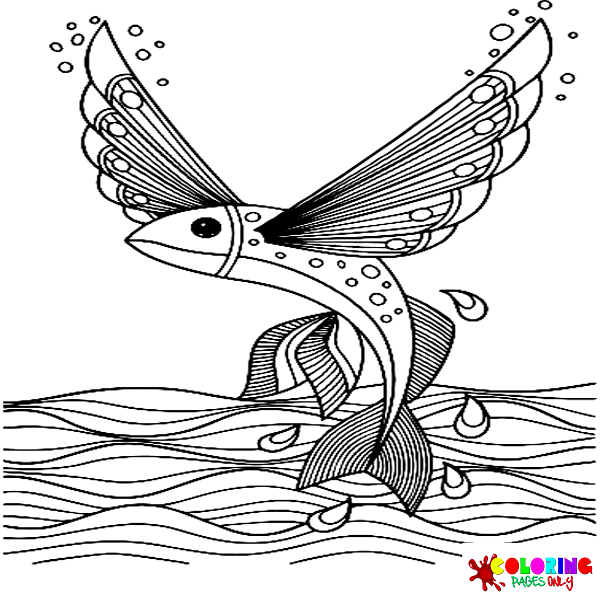
Free fish coloring pages: 1,320+ pages spanning the full visual breadth of aquatic vertebrate life, including clownfish in their orange-and-white stripe pattern alongside sea anemone companions, koi in traditional Japanese pond compositions, goldfish in bowl and pond settings, angelfish with their dramatic tall body and flowing fins, betta fish in full fin-display poses, tropical reef fish from parrotfish through surgeonfish and butterfly fish, the mandarin dragonet’s extraordinary blue-green-orange patterning, lionfish with their vivid striped venomous-spine display, seahorse portraits with textured armor plating, pufferfish at rest and inflated, piranha close-up tooth-and-eye studies, deep-sea anglerfish with their bioluminescent lures, salmon in river spawning runs, catfish with barbel detail, cartoon and kawaii fish for young colorists, mandala-style fish compositions, fish-in-habitat scenes spanning coral reef through Amazon River through mountain stream, and the full visual vocabulary of the animal group that represents more than half of all vertebrate species on Earth. All free, printable PDFs and online coloring for ocean and freshwater enthusiasts of all ages.
Fish are the most species-diverse group of vertebrates: approximately 34,000 known species, representing more than 50 percent of all vertebrate life on Earth. They inhabit virtually every aquatic environment from the Mariana Trench (where Pseudoliparis swirei, a snailfish, was recorded at a depth of 8,336 meters in 2023, the deepest fish ever documented) to high-altitude Himalayan streams above 5,000 meters. They range in size from Paedocypris progenetica, an adult female reaching approximately 7.9 millimeters, to the whale shark (Rhincodon typus), which reaches confirmed lengths of 12.65 meters (41.5 feet) and is the largest fish alive today.
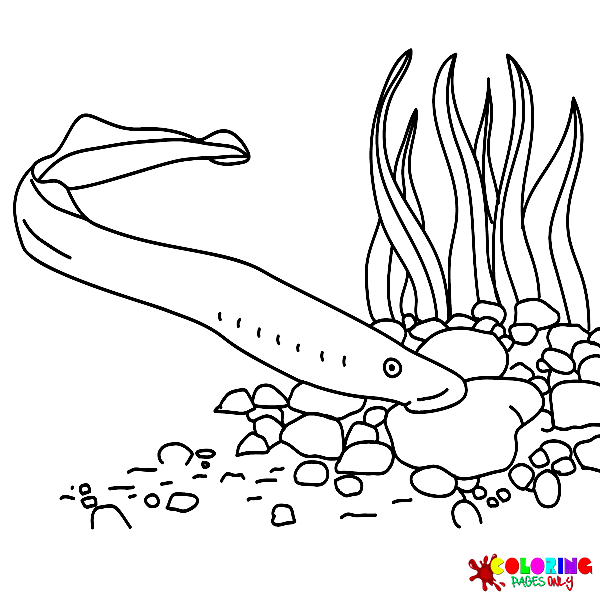
Fish are divided into three major classes. Agnatha (jawless fish) are the most ancient, including lampreys and hagfish, whose body plan predates the evolution of jaws by hundreds of millions of years. Chondrichthyes (cartilaginous fish) include sharks, rays, and skates, whose skeletons are made of cartilage rather than bone. Osteichthyes (bony fish) include the vast majority of species in the group and all the most commonly depicted fish in coloring pages.
Fish have been documented in cave paintings dating to approximately 30,000 years ago. The koi’s association with perseverance and good fortune in Chinese and Japanese culture, the goldfish’s 1,400-year history of deliberate selective breeding beginning in Tang Dynasty China (618-907 CE), and the Christian ichthys symbol establish fish across as many cultural contexts as any animal group in human history.
These 1,320+ free pages at ColoringPagesOnly.com cover the full fish family. All free, PDF or PNG, print or color online.
What’s Inside
Clownfish Pages
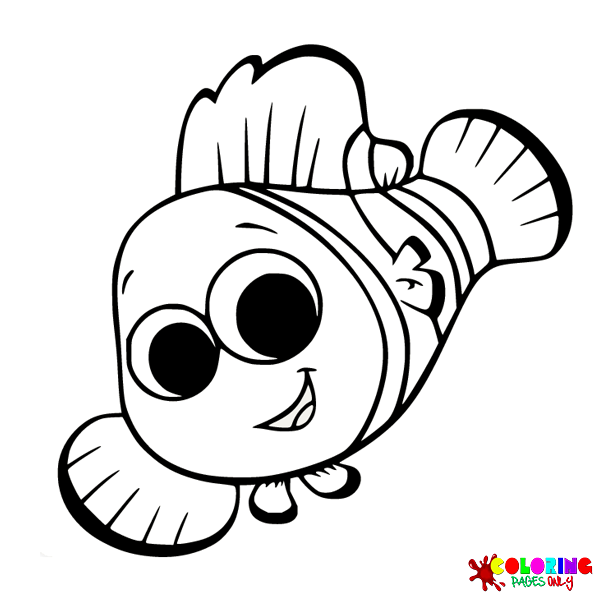
The clownfish (subfamily Amphiprioninae, approximately 28 to 30 species) is the most immediately recognizable tropical marine fish in popular culture, primarily because of its starring role in Pixar’s Finding Nemo (2003) and Finding Dory (2016). The most depicted species in the collection is the common clownfish or false percula clownfish (Amphiprion ocellaris): a vivid orange body with three vertical white stripes, each white stripe bordered on both sides by a thin black line.
The clownfish’s relationship with sea anemones is one of marine biology’s most studied examples of mutualistic symbiosis: the clownfish lives within the sea anemone’s stinging tentacles, which would kill most other fish, but which the clownfish is immune to through a protective mucus coating. The fish benefits from the anemone’s protection and leftover food; the anemone benefits from the fish’s cleaning activities and from the water circulation the fish creates by moving through the tentacles.
All clownfish are born male. The dominant individual in any anemone group changes sex to become the only female, who is larger than all males in the group. If the female dies, the largest male changes sex to replace her. This sequential hermaphroditism is documented in all known clownfish species.
Coloring clownfish pages: The body is vivid,d warm orange at full saturation across all orange sections. The three white stripes are very pale cream or pure white, clearly distinct from the orange. The black border lines between the orange body and each white stripe are the most precise element: apply near-black at the stripe boundaries, keeping the lines uniform in width. Eyes are vivid orange with a dark pupil.
Koi Fish Pages
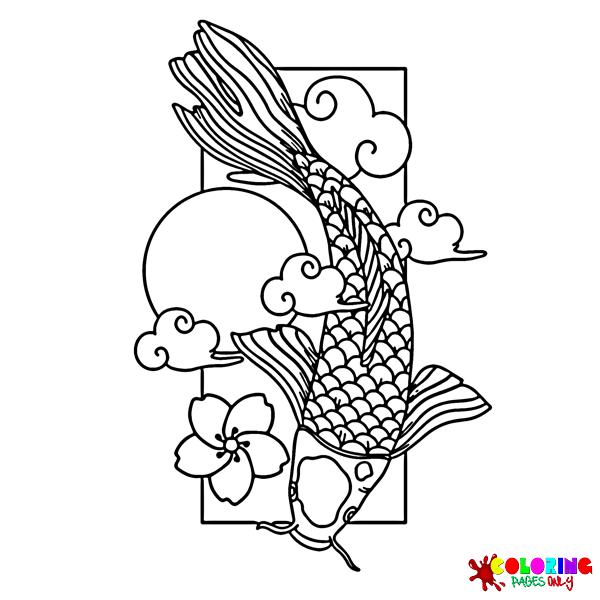
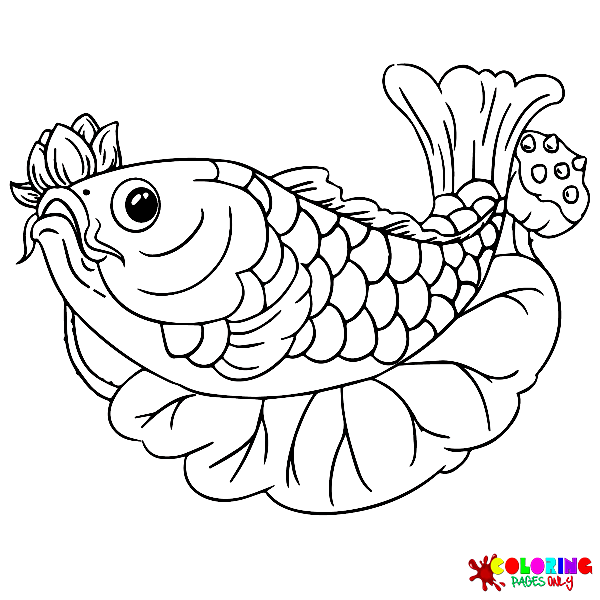
Koi (Cyprinus rubrofuscus, the domesticated form) are a culturally specific coloring subject: the most elaborately valued aquatic animal in the history of ornamental fish keeping, with individual specimens commanding prices comparable to luxury automobiles and, in record cases, significantly beyond. A specific koi named S Legend was sold at the Sakai Fish Farm auction in Hiroshima in 2018 for approximately $1.8 million. They can live 20 to 35 years under good care, and some individuals have been documented at over 200 years old, though this figure is disputed.
Koi were first selectively bred in Japan from common carp (Cyprinus carpio) in the Niigata Prefecture during the 19th century, with the first recorded intentional color breeding documented in the 1820s. The word “koi” in Japanese means “carp,” though in English it specifically refers to the ornamental varieties.
In Chinese culture, fish (鱼, yú) sounds nearly identical to “surplus” or “abundance” (余, also yú), making fish imagery specifically associated with prosperity and good fortune. Koi in Chinese and Japanese art represent perseverance: the legend that koi swimming upstream that successfully leap the Yellow River’s “Dragon Gate” rapids transform into dragons.
The named varieties of koi (Kohaku, Taisho Sanke, Showa, Utsuri, Bekko, Asagi, Shusui, Koromo, Ogon, and others) each have specific color pattern requirements that give koi pages their specific coloring challenge: each variety’s pattern is a precise combination of specific colors in specific positions on the body.
Coloring koi pages: Kohaku (the most classic): pure white body with vivid red-orange patches (hi) that must be clearly defined against the white. Taisho Sanke: white base with both red patches and black (sumi) patches in a three-color composition. Ogon: metallic single-color varieties in gold, silver, or platinum: apply with the metallic three-zone technique for gleaming quality. The black (sumi) in any variety uses near-black at full coverage with clean edges against the white or red areas.
Goldfish Pages
The goldfish (Carassius auratus) is the world’s oldest ornamental fish: selective breeding from wild carp began in China during the Tang Dynasty (618-907 CE) and accelerated during the Song Dynasty (960-1279 CE), when gold, silver, and various color forms were established through artificial selection. The first export of goldfish to Japan is documented in the 1600s, and to Europe in the late 17th century.
From this single species, centuries of selective breeding have produced hundreds of distinct varieties with dramatically different body forms, fin types, and color patterns. The common goldfish retains the most fish-like proportions, with a streamlined body and short fins. The fantail and ryukin have round, ball-like bodies and double tails. The oranda has a distinctive head growth called a wen (resembling a brain or cauliflower). The telescope (or dragon eye) goldfish has enormous protruding eyes. The lionhead and ranchu have no dorsal fin. The celestial eye has eyes permanently directed upward. The pearlscale has round, convex scales that give the body a textured, pearlescent surface.
Coloring goldfish pages: The classic orange-gold is a specific war, a vivid orange, more orange than yellow, and with enough red to read as distinctly warmer than a standard orange. Metallic goldfish varieties (ryukin, oranda in their gold forms) benefit from the metallic three-zone technique: lighter gold at the scales’ top surfaces, mid-gold on the scale faces, slightly deeper amber at the scale edges where they overlap. The fantail and similar varieties’ double tails are the most elaborate fin structures in the collection, requiring careful attention to the translucent fin membrane areas.
Tropical Reef Fish Pages
The coral reef ecosystem supports approximately 25 percent of all marine species on a habitat that covers less than 1 percent of the ocean floor. The chromatic diversity of reef fish is the direct product of evolutionary pressure in this visually complex, species-rich environment: vivid patterns serve as species recognition signals, warning coloration (advertising toxicity or venomousness), camouflage against specific reef backgrounds, and social communication.
The mandarin dragonet (Synchiropus splendidus) is widely considered the most vivid fish in the world: a combination of electric blue, vivid green, and vivid orange in a complex labyrinthine pattern on a body approximately 6 centimeters long. It does not have traditional scales; its skin is covered in a bitter, toxic mucus that makes it one of the few reef fish that predators reliably avoid. Its blue pigmentation uses the pigment cyanophycin rather than structural coloration, making it one of the few animals with a genuine blue pigment.
The parrotfish (family Scaridae) scrape algae from coral, in the process consuming coral substrate and excreting it as fine white sand: much of the white sand on tropical beaches consists of parrotfish digestive output. A large parrotfish can produce up to 90 kilograms of sand per year.
Coloring reef fish pages: The mandarin dragonet uses electric blue at maximum saturation as the background color with vivid green pattern lines over it and vivid orange-red in the pattern’s remaining areas. No muted tones: every color at full vivid saturation. Parrotfish use the specific blue-green to pink-red gradients of their species’ terminal phase coloration. Surgeonfish (like Dory from Finding Nemo) use a vivid royal blue body with a black mask and a yellow tail.
Betta Fish Pages
The betta fish or Siamese fighting fish (Betta splendens) is native to Thailand (formerly Siam) and its surrounding region, where wild bettas live in rice paddies, shallow ponds, and slow-moving streams. They were first documented in systematic Western scientific literature in 1849 by Theodore Cantor. Selective breeding in Thailand began before Western documentation: organized betta fighting (in which males are pitted against each other for their aggressive territorial behavior) had been formalized as a gambling activity by the time of Thai documentation in the 1800s.
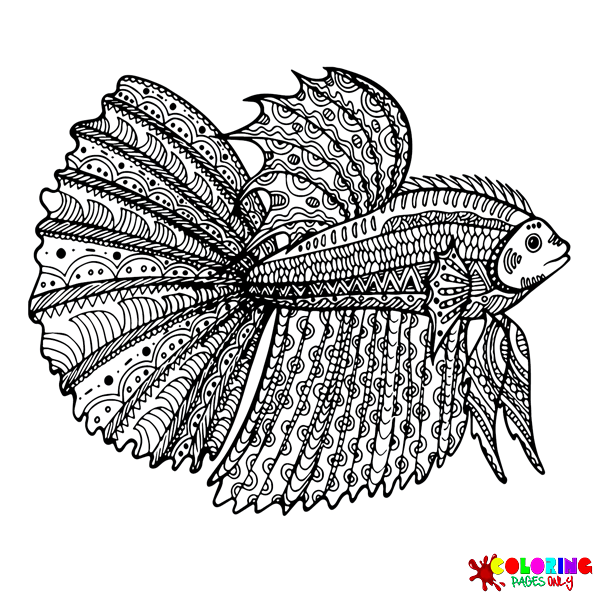
The wild-type betta has relatively short fins and muted coloration. Generations of selective breeding for the ornamental market have produced varieties with dramatically extended finnage: the veiltail (long, drooping single tail), the crown tail (tails with extensive webbing removed creating a crown-like fringe), the halfmoon (tail spread in a perfect 180-degree arc), the double tail, and the rose tail (so much fin material it folds on itself). Colors span the full spectrum in solid, bicolor, and multicolor patterns.
Bettas can breathe air using the labyrinth organ, a specialized chamber adjacent to the gills that allows them to extract oxygen from air at the water’s surface. This adaptation developed in response to the low-oxygen shallow water environments they naturally inhabit.
Coloring betta fish pages: The fin surfaces are the most elaborate coloring challenge in the collection: large, flowing fin surfaces in the halfmoon or crown tail varieties can take up as much page area as the body itself. Apply the primary color at full saturation across the fin membrane area, then add the secondary color in the specific pattern (often iridescent-suggesting tones at the fin’s margins). The metallic or iridescent quality of betta coloration can be suggested by applying a slightly lighter tone at the fin’s center and a slightly deeper tone at its edges.
Seahorse Pages
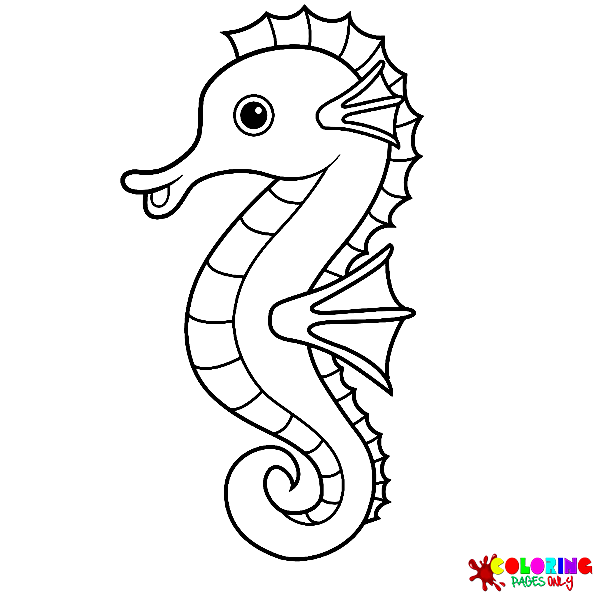
Seahorses (genus Hippocampus, approximately 46 species) are fish in every biological classification while appearing nothing like what the word “fish” conventionally suggests: they swim upright, they have no caudal fin for propulsion (they use their dorsal fin, which beats at approximately 35 times per second, too fast for the naked eye to see), they have bony armor plates rather than scales, and the males rather than females carry the developing young in a specialized brood pouch on the father’s abdomen.
Seahorse reproduction is the most unusual in the fish world: the female deposits eggs into the male’s brood pouch, where he fertilizes them and carries them through gestation, then gives birth to up to 1,500 live young through muscular contractions. The male is technically the pregnant individual.
They are among the slowest fish: Hippocampus zosterae (the dwarf seahorse) holds the Guinness World Record as the slowest fish, with a maximum recorded speed of approximately 1.5 meters per hour. They maintain their position in currents by anchoring their prehensile tail to seagrass or coral.
Coloring seahorse pages: The seahorse’s body armor (bony plates called scutes) creates a naturally segmented texture that distinguishes seahorse coloring from smooth-bodied fish. Apply the base body color at full coverage, then add slightly darker tones at the boundary between each body segment/ring. The coronet (the crown-like bony structure at the top of the head) is the most detailed single element: it is unique to each seahorse. Colors range from yellow and orange through brown, grey, and spotted patterns, often with the specific pattern of their background habitat.
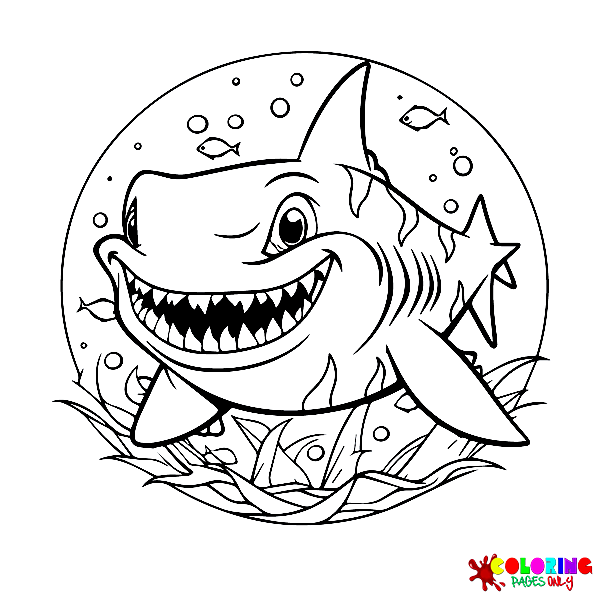
Shark Pages
Sharks (superorder Selachimorpha, approximately 500+ species) are the collection’s most dramatically imposing fish subjects. They are Chondrichthyes: their skeletons are made entirely of cartilage rather than bone, which is lighter and more flexible than bone and provides the specific body shape flexibility that makes large sharks effective pursuit predators.
The great white shark (Carcharodon carcharias) is the most depicted in popular culture, primarily through Steven Spielberg’s Jaws (1975). Great whites reach confirmed lengths of approximately 6.1 meters and weights of approximately 1,905 kilograms. They are partially endothermic (warm-blooded): they can regulate certain body temperatures above ambient water temperature, which enhances muscle performance in cold water.
The whale shark (Rhincodon typus) is the largest fish alive: up to 12.65 meters in confirmed measurements, with unconfirmed reports of larger. Despite its size, it is a filter feeder consuming plankton, krill, and small fish, posing no danger to humans.
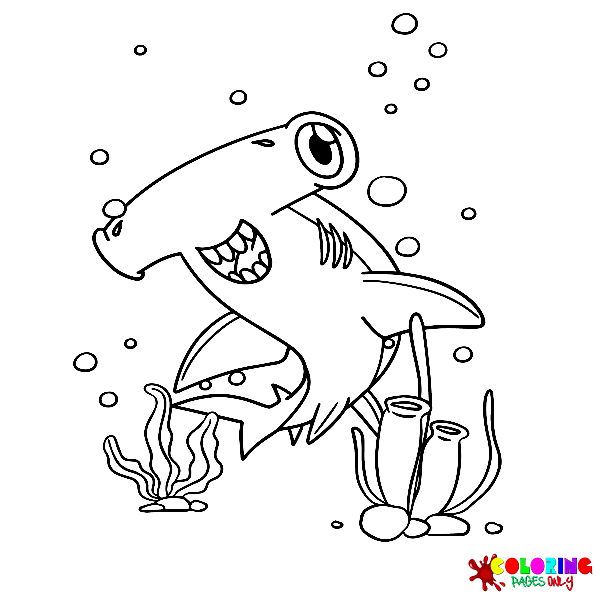
Coloring shark pages: Great white: the upper body is grey to dark grey-blue, the underside (belly) is clean white. The division between grey upper and white lower is a clean, clearly defined boundary that runs from the snout along the body’s lateral line to the tail. Hammerhead: the same grey upper and white lower, but with the distinctive hammer-shaped head (cephalofoil) requiring attention to the specific shape. Whale shark: dark grey with a grid-like pattern of lighter pale spots and stripes across the upper body.
Deep-Sea and Unusual Fish Pages
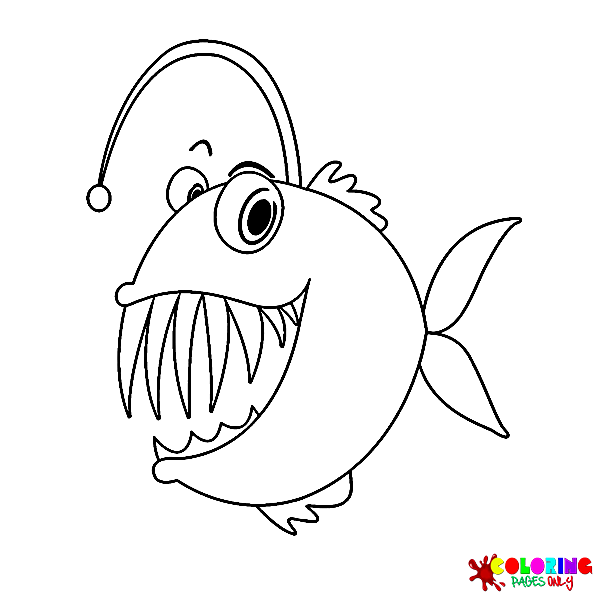
The anglerfish (order Lophiiformes) uses a bioluminescent lure (the esca) dangling from a modified dorsal spine above the mouth to attract prey in the complete darkness of the deep ocean. The bioluminescence is produced not by the fish itself but by symbiotic bacteria living within the esca—the light pulses in patterns that attract small fish and invertebrates toward the anglerfish’s enormous jaws.
The pufferfish (family Tetraodontidae) can inflate its body to several times its normal size by rapidly ingesting water, creating a round, spine-covered ball that most predators cannot swallow. Many pufferfish species contain tetrodotoxin, one of the most potent neurotoxins known, concentrated primarily in the liver, ovaries, skin, and intestines. In Japan, pufferfish (fugu) is served as a delicacy; preparation requires certification because incorrect preparation is fatal. Approximately 30 to 50 people die from improperly prepared fugu annually in Japan despite the certification system.
Coloring deep-sea fish pages: The anglerfish uses very dark grey or near-black for the deep-sea-adapted body, with the esca rendered in vivid blue or blue-green bioluminescent light against the dark body. The pufferfish uses its specific species’ coloring: many are yellow and white, some are brown and spotted, and the most vivid species use vivid yellow-green or blue-green.
What These Pages Do
Fish are represented in the earliest known cave art: the cave paintings at Pech Merle in France (approximately 25,000 years ago) include fish, and fish imagery appears across Upper Paleolithic sites internationally. This continuous documented presence of fish in human art across 25,000 years establishes the coloring pages in this collection as part of one of human visual culture’s oldest sustained subjects.
The economic importance of fish to human civilizations has been foundational across cultures: fishing is documented as a food source in virtually every coastal and river-adjacent human society for the full extent of the archaeological record. Commercial fishing currently represents an industry providing protein to more than 3.3 billion people globally (World Health Organization estimates) and supporting hundreds of millions of livelihoods.
Fish biology provides the collection’s educational depth. The scale aging technique (using scale ring counts to determine a fish’s age, analogous to tree rings) is used by fisheries scientists worldwide. The lateral line sensory system, which detects vibrations and pressure changes in water and has no direct human anatomical equivalent, is one of biology’s most specifically interesting sensory systems.
The American Academy of Pediatrics identifies fine motor skill development as a key childhood milestone throughout early childhood. The koi pattern precision, the tropical reef fish’s complex pattern rendering, the betta fin’s large flowing surfaces, the seahorse’s segmented armor plating, and the scale texture technique across all realistic fish pages provide sustained fine motor challenge across the collection’s extremely wide age range. The 2005 Art Therapy Journal study on structured coloring and anxiety reduction applies throughout.
How to Color These Pages Well
Scale texture on realistic fish pages uses three tones applied in overlapping rows. Apply the base body color at full coverage. Then identify the direction of scale rows (typically from head toward tail, each row slightly overlapping the one ahead of it). Apply a slightly darker tone at the bottom edge of each scale where it overlaps the next scale forward, creating the shadow line that makes individual scales readable. Finally, apply a slightly lighter tone at the top center of each scale where light catches the curved surface. The resulting three-zone pattern (light at scale top, mid-tone across scale face, dark at scale overlap edge) creates realistic scale texture across any fish page.
Tropical reef fish require maximum saturation for every color throughout the full composition. The reef environment’s evolutionary pressure for vivid coloration means that desaturated or muted tones on tropical reef fish pages read as incorrect. Apply every color at maximum saturation and maximum pressure. The vivid blue of a surgeonfish, the vivid orange of a clownfish, and the electric blue-green of a mandarin dragonet should all read as the most vivid version of their respective colors available.
The koi’s white areas must be kept clean and unpainted throughout the full coloring process. Koi coloring depends on the contrast between the white base and the colored patches. Any contamination of the white areas by surrounding colors destroys the variety’s specific visual identity. Apply the white areas last, protecting them throughout the entire coloring process, or plan the coloring sequence to work from the white boundary outward rather than toward it.
Translucent fin areas on betta and angelfish pages use the same color as the body, but at significantly reduced pressure. The long fins of betta fish and many tropical fish are translucent: the coloring shows through the fin membrane less intensely than through the opaque body. Apply the fin color at 40 to 60 percent of the pressure used for the body, which produces a visually lighter, more transparent result that distinguishes the fin from the body without using a different color.
The lateral line on most fish pages is the single most important anatomical accuracy detail. The lateral line (the sensory organ running along the fish’s side, visible as a slight color difference or a row of small pores in life) appears in many realistic fish page designs as a line along the body’s midpoint from gill to tail. Render it as a slightly darker version of the body color in a thin, continuous line: darker than the surrounding scale color but not dramatically so, reading as a subtle feature rather than a bold marking.
5 Creative Craft Ideas
The Scale Ring Age Study
Fish scales, like tree rings, record annual growth: in temperate climates, fish grow rapidly in summer (producing wide, light-toned ring sections) and slowly in winter (producing narrow, dark ring sections). The resulting alternating pattern allows scientists to count a fish’s age by examining its scales under a microscope, a technique called scale reading.
Print a large, detailed fish page. Color the scales using the annual ring technique: apply light pressure, warm gold for the “summer growth” area of each scale, and slightly darker warm amber for the “winter” narrow band. Build this pattern into each scale across the full body.
On the backing card: “Fish scale aging. Annual growth rings: formed by the alternating fast growth of summer (light rings) and slow growth of winter (dark rings) in the scale material. The rings are called annuli (singular: annulus). Method: identical in principle to counting tree rings. Used by: fisheries scientists worldwide to determine a fish’s age without killing it. A fish whose scales show 10 complete ring pairs: approximately 10 years old. The oldest confirmed fish age by scales: approximately 205 years for a rougheye rockfish (Sebastes aleutianus). This coloring page: demonstrating the technique.”
The Koi Variety Collection
The principal koi varieties each have specific color requirements that are defined in the formal Japanese koi judging standards maintained by the Zen Nippon Airinkai (ZNA) and similar organizations. Print five copies of the same koi page. Color each in a different-named variety.
Kohaku: white base, vivid red-orange (hi) patches only. Taisho Sanke: white base, vivid red patches, and black (sumi) patches. Showa: black base with vivid red and white patches. Ogon: entirely metallic gold (apply with the three-zone metallic technique). Bekko: white, red, or yellow base with black patches only.
On the backing card, label each variety with its name and the simple color rule: “Koi varieties and their color rules. Kohaku: white and red only. Taisho Sanke: white, red, and black. Showa: black base with red and white. Ogon: solid metallic. Bekko: solid base with black spots only. The koi hobby: one of the world’s most extensively systematized animal color standards. The record individual sale: approximately $1.8 million (S Legend, 2018). Selective breeding began in Niigata Prefecture, Japan, in the 1820s.
The Bioluminescent Deep Sea Page
The deep sea below 200 meters receives no sunlight. Many fish in this zone produce bioluminescence: the anglerfish uses it to lure prey; the viperfish uses light-producing organs along its body for camouflage (called counterillumination, which matches the faint light from above to make the fish invisible from below); the lanternfish (Myctophidae) produces complex species-specific light patterns.
Print any deep-sea fish page. Color the background near-black at full coverage. Apply the bioluminescent elements in vivid blue or blue-green.
On the backing card: “The deep sea below 200 meters: no sunlight. Estimated 76% of deep-sea fish produce bioluminescence. The anglerfish’s esca (lure): light produced by symbiotic bacteria, not by the fish itself. The record depth for a living fish: 8,336 meters (Pseudoliparis swirei, snailfish, 2023). At 8,336 meters, water pressure is approximately 836 times sea-level atmospheric pressure. The anglerfish does not find this remarkable. It has no frame of reference for another environment. Color the background first. The fish comes after.”
The Seahorse Gender Study
In seahorse reproduction, the female deposits eggs into the male’s specialized brood pouch on his abdomen, where he fertilizes them internally and carries them through gestation, then gives birth to live young through muscular contractions. The male is the pregnant individual. The male can give birth to up to 1,500 young in a single pregnancy. After birth, the female courts the male again, establishing one of marine biology’s best-documented examples of male parental investment.
Print a pair of seahorse pages or two copies of the same page. Color one seahorse in lighter tones (the female) and one with the specific swollen brood pouch visible in the mid-body area (the pregnant male).
On the backing card: “Seahorse reproduction. The pregnant individual: the male. Process: female deposits eggs into the male’s specialized brood pouch on his abdomen. Male fertilizes internally. Males carry young through gestation (10-45 days depending on species). The male gives birth through muscular contractions. Young at birth: up to 1,500. After birth, the female begins courting the male again. The seahorse’s swimming speed: the dwarf seahorse (Hippocampus zosterae) holds the Guinness World Record as the slowest fish (approximately 1.5 meters per hour). The male is the one who gave birth to that slow record holder.”
The Reef Fish Color Function Study
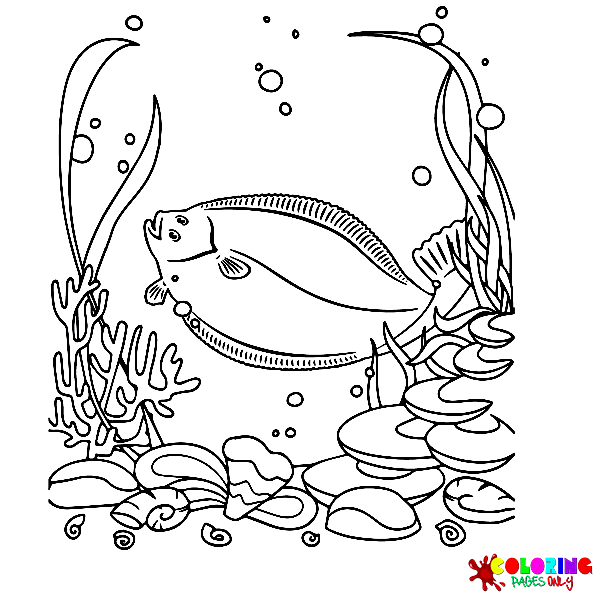
The vivid colors of coral reef fish are not decorative in the human-interest sense: they serve specific biological functions in a visually complex, species-rich environment. The clownfish’s orange and white signals its presence to the anemone (and warns other clownfish). The parrotfish’s terminal phase male coloration signals reproductive status to females. The lionfish’s vivid striped pattern warns predators of its venomous spines (aposematism). The flounder’s ability to change its pattern to match the substrate beneath it is camouflage.
Print one page each of a clownfish, a parrotfish, a lionfish, and a flounder (or any flatfish). Color each in its canonical colors.
On the backing card: “Reef fish color: four functions. Species recognition (clownfish orange-and-white: signals to its own species and to the anemone). Aposematism/warning (lionfish vivid stripes: signals venomous spines to potential predators). Camouflage (flounder: can change body pattern to match substrate; no vivid color). Sexual signaling (parrotfish terminal phase male: vivid blue-green signals reproductive status). The coral reef ecosystem covers less than 1% of the ocean floor. Hosts: approximately 25% of all marine species. The colors: not accidental. Each one is doing something specific.”
Frequently Asked Questions
How many species of fish exist, and where are they found? Approximately 34,000 known species of fish have been identified, representing more than 50 percent of all vertebrate species on Earth and making fish the most species-diverse vertebrate group. They inhabit virtually every aquatic environment: from the deepest ocean trenches (a snailfish, Pseudoliparis swirei, was recorded at 8,336 meters depth in 2023, the deepest fish ever documented) to high-altitude mountain streams above 5,000 meters, from polar ice-shelf waters to desert springs with temperatures exceeding 40°C. The Amazon basin alone contains more freshwater fish species than the entire European continent. Fish are divided into three major classes: Agnatha (jawless fish: lampreys and hagfish), Chondrichthyes (cartilaginous fish: sharks, rays, skates), and Osteichthyes (bony fish: the vast majority of species).
What makes tropical fish so vividly colored compared to other fish? The vivid coloration of tropical reef fish is the product of evolutionary pressure in a visually complex, species-rich environment where visual signals serve multiple critical biological functions simultaneously. Colors serve as species recognition signals (allowing fish to identify their own species among hundreds of similar-sized fish on the same reef), as aposematic (warning) coloration (advertising venomousness or toxicity to potential predators), as camouflage signals (some reef fish match specific coral types), and as sexual communication (different color patterns signal reproductive status between males and females). The mandarin dragonet (Synchiropus splendidus) uses vivid electric blue, green, and orange pigments rather than structural coloration (light-refracting microscopic structures). It is one of the few animals with a genuine blue pigment. The coral reef ecosystem supports approximately 25 percent of all marine species despite covering less than 1 percent of the ocean floor.
What is the cultural significance of koi fish? Koi (Cyprinus rubrofuscus, the domesticated ornamental carp) have been selectively bred in Japan since at least the 1820s in Niigata Prefecture, where the first intentional color breeding from common carp is historically documented. In Chinese culture, the word for fish (鱼, yú) is phonetically nearly identical to the word for surplus or abundance (余, also yú), making fish imagery specifically associated with prosperity and good fortune. The legend that koi swimming upstream that successfully leap the “Dragon Gate” waterfall of the Yellow River transform into dragons has made koi a symbol of perseverance in both Chinese and Japanese culture. Individual koi specimens have sold for prices approaching or exceeding $2 million at specialized auction events. Koi can live 20 to 35 years under good care, with some individuals documented at considerably longer lifespans.
Why are seahorses unusual among fish? Seahorses (genus Hippocampus, approximately 46 species) depart from fish conventions in several documented ways. They are the only fish in which the male, rather than the female,e is pregnant: the female deposits eggs into the male’s specialized abdominal brood pouch, where he fertilizes them and carries the developing young through gestation before giving birth to up to 1,500 live young through muscular contractions. They swim upright rather than horizontally. They have no caudal fin for propulsion, relying instead on their dorsal fin (which beats approximately 35 times per second) for movement. They have bony armor plates (scutes) rather than scales. They use their prehensile tail to anchor to seagrass, coral, or other structures against currents. The dwarf seahorse (Hippocampus zosterae) holds the Guinness World Record as the slowest fish, with a maximum recorded speed of approximately 1.5 meters per hour.
What is the connection between goldfish and Chinese history? The goldfish (Carassius auratus) is the world’s oldest ornamental fish, with selective breeding from wild crucian carp documented in China during the Tang Dynasty (618-907 CE). Natural mutations producing gold and silver coloration appeared in pond cultures maintained for food. They were preserved and selectively bred during the Song Dynasty (960-1279 CE), when domesticated goldfish keeping became widespread across social classes in China. The first recorded export of goldfish to Japan is documented in the early 17th century, and to Europe in the late 17th century. Centuries of subsequent selective breeding across multiple countries have produced hundreds of distinct varieties with dramatically different body forms, fin types, scale types, and color patterns, all derived from the same original species.
How do fish breathe, and what is the lateral line? Most fish extract dissolved oxygen from water using gills: the water passes over thin, blood-vessel-rich gill filaments where oxygen diffuses into the blood and carbon dioxide diffuses out. Some fish can also breathe air: labyrinth fish (bettas, gouramis) have a specialized air-breathing organ that allows them to extract oxygen from the surface, which evolved in low-oxygen environments. Lungfish (order Dipnoi) have true lung-like organs, and some species can survive extended droughts buried in dried mud. The lateral line is a sensory system unique to fish and some amphibians: a row of sensory receptors (neuromasts) that detect water pressure changes, vibrations, and water movement, running along the fish’s side from head to tail. It allows fish to detect prey, predators, currents, and obstacles without visual contact, functioning as a pressure and vibration sense that has no direct equivalent in human physiology.
What age group are these pages best suited for? Fish coloring pages serve the widest possible age range within the collection. The simplest cartoon and kawaii fish pages with large,e rounded bodies and minimal detail are accessible from ages two and three, where the basic fish shape and bold single colors provide clear, achievable coloring targets. The clownfish’s orange-and-white stripe pattern and the goldfish’s simple, solid-color design are most rewarding for ages three to six. The koi variety pattern pages requiring distinct color zones and the seahorse’s segmented armor texture are most engaging for ages five to ten. The tropical reef fish with complex pattern rendering, the betta fish with elaborate fin structures, the deep-sea anglerfish, and the scale texture technique pages are most appropriate for ages eight and up. Adult aquarists, fishkeepers, and marine biology enthusiasts find the most detailed species-specific pages and the scientific context craft projects most personally engaging.
Browse the full collection at ColoringPagesOnly.com. All 1,320+ pages free, no sign-up, PDF or PNG, print or color online.
Fish appeared in cave paintings approximately 25,000 years ago. They are in the Pech Merle cave in France. They appear in the earliest systematized Chinese imperial records.—The word for fish in Chinese sounds identical to the word for abundance. Someone in the Tang Dynasty noticed a gold mutation in a pond of carp and decided to keep it. That was approximately 1,400 years ago. The goldfish is still here.
The mandarin dragonet is the most vivid animal on Earth. It is approximately 6 centimeters long. Its blue is one of the few genuine blue pigments found in any animal. It lives on coral reefs and is covered in bitter, toxic mucus, so predators leave it alone. It is very vivid and very untroubled.
The seahorse male gives birth. The female courts him after. He is the slowest fish. He has bony armor. He is technically a fish. He is nothing like what that word usually means.
Pick up your most vivid warm orange for the clownfish. Three white stripes with black borders. Apply the white last, protected throughout. Pick up your lightest available color for the moon jellyfish bell: it is 95 percent water. Apply the scale texture in three tones, working head to tail.
Share your work on Facebook and Pinterest and tag #Coloringpagesonly. The koi variety collection and the reef fish color function study are particularly worth sharing.
Color the scale base first. Apply mid-tone on each scale face. Add the shadow at each overlap edge. The lateral line runs from the gill to the tail. Apply it slightly darker than the surrounding scales. The fish has been using it to detect everything around it for 500 million years.